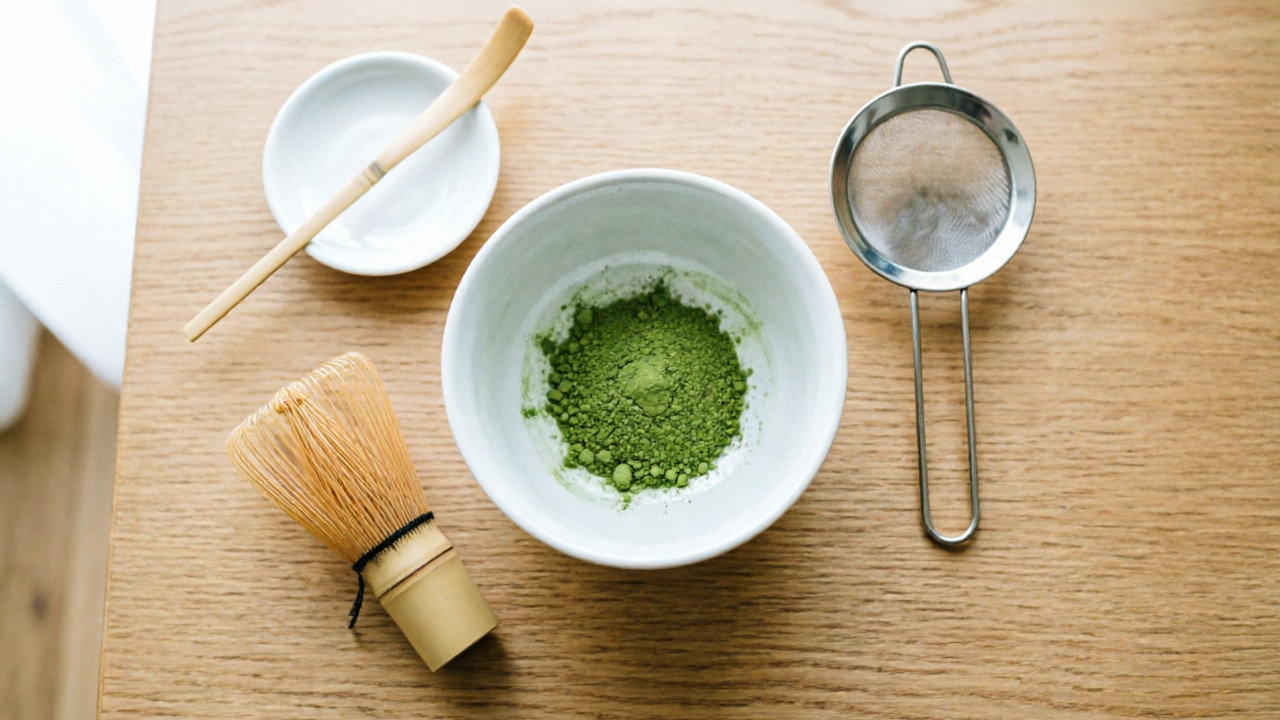
This guide takes you from the matcha tin to a frothed chawan in 60 seconds, then explains the chemistry behind each step - the 80 °C boundary that protects chlorophyll, the W-motion that incorporates air into a vortex, the difference between ceremonial and culinary grades. Each step has a reason rooted in either tradition or food science, and each is something a recipe blog won’t tell you. For the full variety context on shade-growing and grade classification, see the Matcha Guide.
Why Matcha Brewing Is Different

Every other tea is steeped and discarded. Matcha is the only tea where you consume the entire leaf - stone-ground into a powder, suspended in water, and drunk whole. That single fact changes the entire brewing process.
Shade-growing for 2-3 weeks before harvest forces the plant to produce more chlorophyll and L-theanine, the amino acid behind matcha’s sweet umami [6]. The same shading keeps catechins (the bitter compounds) lower than in sun-grown tea. The result is a powder that’s uniquely sensitive to water temperature - too hot and you extract the bitterness the shade was meant to suppress.
The 80 °C boundary matters more here than for any other tea. Brew matcha at 90 °C and the cup turns aggressively bitter because you’re consuming the full leaf, not just an infusion [1].
Choosing a Grade for Brewing
Not all matcha is meant for drinking straight. The three-tier system exists for a reason - each grade has a different catechin-to-L-theanine ratio that determines where it works.
Ceremonial (Usucha, Koicha, Straight Drinking)
First-harvest, shade-grown for 3+ weeks, stone-ground. Sweet umami with almost no bitterness. This is the only grade for traditional usucha. Naoki Matcha Superior Ceremonial, $24.99/40g is a representative first-harvest ceremonial grade that works for both thin and thick tea. Expect $20-40 for a 30 g tin [3].
Premium (Daily Usucha, Balance)
First or second harvest, shaded for about 2 weeks. Slightly more astringent than ceremonial but still smooth enough for straight usucha. A good daily cup at $15-25/30g. If you drink matcha every morning and don’t want to spend ceremonial prices, this is the tier.
Culinary (Lattes, Baking)
Later harvest, less shade, higher catechin content. Too bitter for straight usucha - the vegetal notes overwhelm the umami. But when mixed with milk, sugar, or flour, the bitterness becomes a flavor backbone. Jade Leaf Organic Culinary Grade, $10.99 is the standard kitchen-grade pick. For the latte version of this brewing method, see our matcha latte recipe.
The Tools (and Why Each One Matters)
Matcha tools are some of the few single-purpose items in tea. Each one solves a problem that no general-purpose kitchen tool handles well.
Chawan (tea bowl). A wide, open bowl that gives the whisk room to move. 12-15 cm across - narrow enough to concentrate powder, wide enough for the W-motion. The Jade Leaf Porcelain Bowl with Pour Spout, $14.99 is a functional starter chawan.
Chasen (whisk). 80-prong bamboo whisk. The prongs flex against the bowl bottom, creating a vortex that incorporates air. A 2-pack chasen, $12.49 gives you a backup when the first wears out (3-6 months daily use).
Chashaku (scoop). Curved bamboo, ~1 g per scoop. Japanese tea schools teach dosing by scoop count. A 2-pack chashaku, $9.99 is the standard.
Sifter. 60-mesh stainless steel. Matcha clumps during storage due to static charge and moisture [5]. A dedicated sifter, $9.99 breaks those clumps before water touches the powder.
Storage tin. Airtight, opaque, refrigerated after opening. An airtight tin, $12.99 blocks light for 4-6 weeks of freshness.
The all-in-one. Starting from zero? The Hario Matcha Tea Set (Clear) – Double-Walled Glass Matcha Bowl with Chasen Whisk, $99.00 bundles bowl, whisk, sifter, and scoop. For a deeper look at each tool, see matcha tools.
The Traditional Method: Usucha in 60 Seconds
-
Sift 2 g matcha (about 2 chashaku scoops or 1 level teaspoon) into the dry chawan through a 60-mesh sifter. Tap the sifter gently - don’t press the powder through. This breaks clumps that won’t dissolve no matter how hard you whisk [5].
-
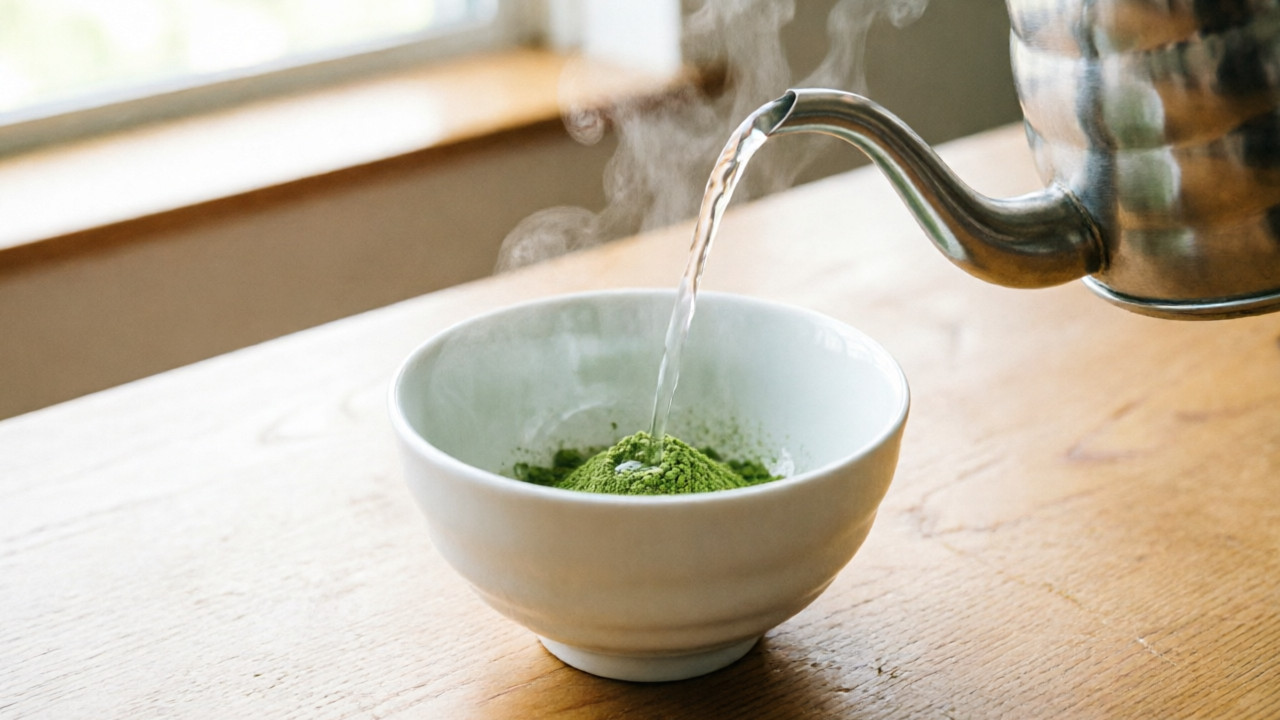
Heat water to 80 °C. Use a temperature-controlled kettle set to 80 °C, or boil and let sit in a separate cup for 90 seconds. Pouring boiling water directly from the kettle will scorch the powder [1].
-
Pour 60 ml of water into the bowl. The water should barely cover the powder. Too much water and the foam won’t form; too little and the suspension will be pasty.
-
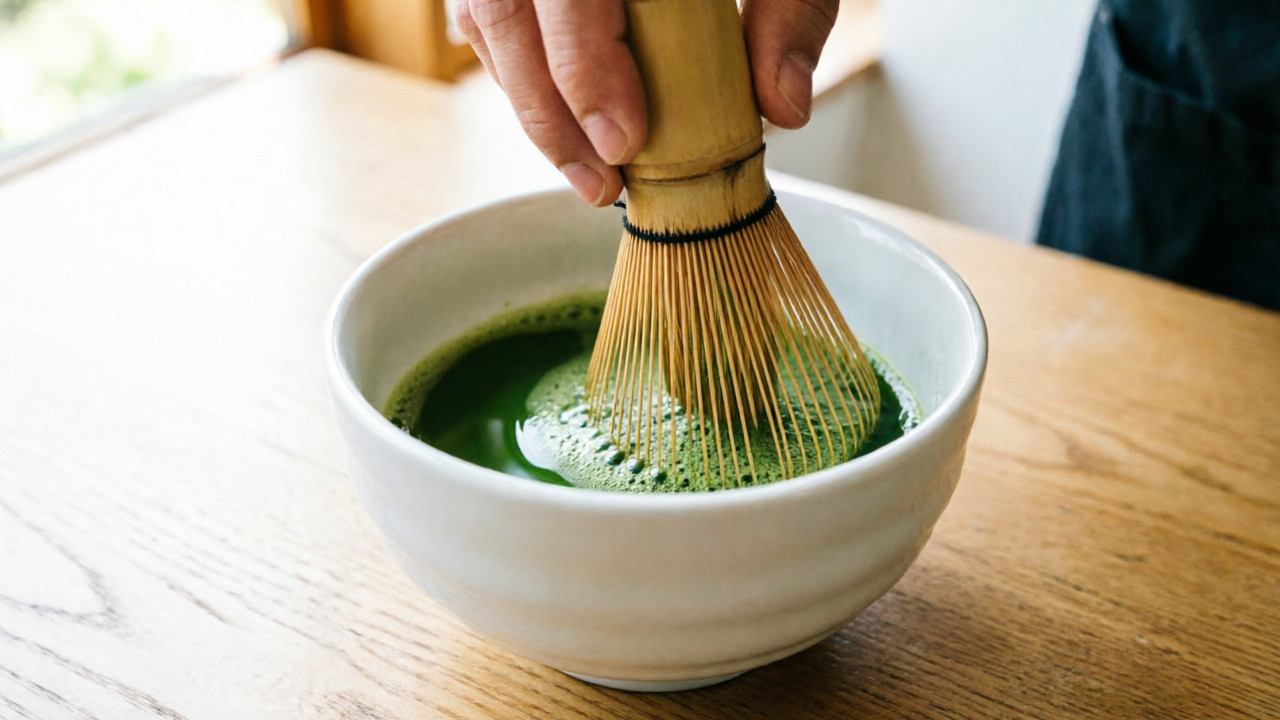
Whisk in a W-motion for 15-20 seconds. Hold the chasen lightly - grip it like a pencil, not a hammer. Move from the wrist, not the arm. Trace a rapid W (or M - both produce the same zig-zag) across the bottom of the bowl. The chasen’s 80 prongs flex against the bowl, creating a vortex that incorporates air into the suspension.
-
Slow down for the last 3 seconds. This breaks the large bubbles and leaves a fine, even microfoam on the surface - the texture should look like soft shaving cream, not soap suds.
-
Lift the chasen and tap once on the bowl rim to release trapped powder. The foam should hold for about 60 seconds.
-
Drink immediately. The suspension settles within 2 minutes. Matcha isn’t a steep-and-wait tea - once it’s whisked, it’s ready. For a milk-based variation of this same method, see our matcha latte recipe.
Koicha: The Thick Tea (Traditional Variation)
Koicha (濃茶, thick tea) is the formal-tea counterpart to everyday usucha. The ratio inverts: 4 g of matcha to just 30 ml of water - twice the powder, half the water [2]. The result is a thick, syrupy liquid closer to melted chocolate than tea.
Koicha is not whisked. Instead, you use the chasen to slowly press and dissolve the powder into the water with a gentle kneading motion. There’s no foam - the goal is complete dissolution without aeration.
This preparation demands the highest-grade ceremonial matcha. At a 1:7.5 ratio, any bitterness is amplified fourfold compared to usucha. Lower grades will clump and taste unbearably astringent. If you’re curious about koicha, start with a ceremonial-grade tin and practice usucha first - the patience of the press is a different skill from the speed of the whisk.
Koicha originated in the chashitsu as a shared-cup experience for formal guests. It’s rarely made outside of ceremony, but understanding the ratio shows why grade matters: at normal concentrations, the difference between ceremonial and premium is subtle. At koicha concentrations, it’s the difference between velvet and sandpaper.
Water Temperature and Ratio (The Science)
Three temperature boundaries define what happens in the bowl:
80 °C (175 °F) - the sweet spot. Hot enough to dissolve the powder and release L-theanine, cool enough to keep catechins from dominating. L-theanine extraction peaks at 80 °C; higher temperatures degrade the amino acid while increasing bitter compound extraction [1].
Below 70 °C (158 °F) - chalky failure. The powder won’t fully emulsify. The cup tastes flat and gritty.
Above 85 °C (185 °F) - astringent. Catechins extract rapidly and overwhelm the L-theanine.
The standard usucha ratio is 2 g : 60 ml (1:30). Extend to 1:40 (2 g : 80 ml) for a lighter cup; compress toward 1:7.5 for koicha. For the full cross-tea-type ratio table, see our leaf-to-water ratio guide.
A gooseneck kettle with temperature presets eliminates the guesswork. Without one, the 90-second cooling method works: boil, pour into a room-temperature cup, wait, then transfer.
Whisking Technique: The W-Motion for Microfoam
The W-motion (called W字 in Japanese guides) traces a zig-zag across the bowl bottom - not stirring, but a rapid shallow pattern that keeps the bristles on the surface while moving laterally [4].
W vs M. Both are correct - both trace the same zig-zag. The key is the lateral motion that creates a vortex. Circular stirring, the most common beginner mistake, pushes powder without aerating.
Timing. 15-20 seconds at moderate speed produces a soft, even foam. Underwhisking leaves clumps and a glossy surface; overwhisking creates large bubbles that collapse within seconds [4].
The chasen’s 80 prongs are what make the microfoam possible. 80 is the standard for usucha - more prongs (100, 120) produce finer foam but are fragile; fewer (48, 60) produce coarser foam but last longer.
For the M-motion latte variation, see the matcha latte recipe.
Common Mistakes (and the Fix for Each)
- Boiling water on the powder. The #1 cause of bitter matcha. Fix: cool to 80 °C, or use a temperature-controlled kettle.
- Skipping the sift. Guarantees clumps that no amount of whisking will dissolve. Fix: a 60-mesh sifter, 5 seconds, tap-and-shake.
- Wrong grade for the use. Culinary grade for straight usucha tastes like grass clippings. Fix: match the grade to the method - ceremonial for drinking, culinary for cooking.
- Whisking in circles. Produces no microfoam. Fix: switch to the W-motion (see above). The matcha latte recipe covers the M-motion variation if you find W uncomfortable.
- Too much or too little powder. Under 1.5 g and the foam won’t hold; over 3 g and the cup turns muddy. Fix: 2 g standard, measured with a chashaku or a kitchen scale.
Without a Whisk: What Actually Works
Sometimes the chasen isn’t available - traveling, office, or you just haven’t bought one yet. Two substitutes work, with trade-offs.
Handheld milk frother. The closest substitute. It breaks clumps and aerates, but the foam is coarser with visible bubbles. A Zulay handheld frother, $8.99 handles the job in 15 seconds. Acceptable for a weekday cup; won’t fool anyone who’s had proper usucha.
Mason jar shake. Sift, add cold water, seal, and shake vigorously for 25-30 seconds. The foam is thick but unstable - and this only works for cold matcha. For the full cold method, see our iced matcha guide.
What doesn’t work: forks, spoons, or chopsticks. They can’t create the vortex that incorporates air.
Recommended Gear
| Item | Product | Price | Badge |
|---|---|---|---|
| Matcha (ceremonial) | Naoki Superior 40g | $24.99 | best pick |
| Starter set | Hario Matcha Tea Set (Clear) – Double-Walled Glass Matcha Bowl with Chasen Whisk | $99.00 | best-starter-set |
| Whisk (chasen) | 2-pack Bamboo Chasen | $12.49 | best-whisk |
| Bowl (chawan) | Jade Leaf Porcelain Bowl | $14.99 | best-bowl |
| Sifter | Stainless Steel Sifter | $9.99 | best-sifter |
| Kettle | Cosori Gooseneck | $69.99 | best-kettle |
If you’re starting from zero, the Hario set covers the tools. Add the Naoki ceremonial tin and Cosori kettle for the full setup at about $194.
The Mind of Matcha Brewing
Matcha brewing is the only tea ritual where you consume the leaf whole - no strainer, no discard. Every step exists to make that consumption smooth: the sift breaks static-charge clumps, the 80 °C water preserves L-theanine, the W-motion emulsifies powder into foam. Sixty seconds of attention turns stone-ground dust into a cup you drink entirely, leaving nothing behind but the bowl.
References
[1] Narukawa, M., et al. (2008). “L-Theanine Elicits an Umami Taste with Inosine 5’-Monophosphate.” Bioscience, Biotechnology, and Biochemistry 72(11). https://doi.org/10.1271/bbb.80328 — L-theanine taste properties. Extraction temperature data: Sari, F. & Velioglu, S. (2011). “Effects of particle size, extraction time and temperature, and derivatization time on determination of theanine in tea.” Journal of Food Composition and Analysis 24(8). https://doi.org/10.1016/j.jfca.2011.04.003 — confirms 80 °C optimal for theanine extraction. Hilal, Y. & Engelhardt, U. H. (2007). “Characterisation of white tea – Comparison to green and black tea.” Journal für Verbraucherschutz und Lebensmittelsicherheit 2. https://doi.org/10.1007/s00003-007-0250-3 — tea composition analysis including theanine content. [2] Marukyu Koyamaen (est. 1703). “How to Enjoy Matcha.” Official guide: usucha 2 g : 60 ml; koicha 4 g : 30 ml. https://www.marukyu-koyamaen.co.jp/english/about-tea/enjoy-matcha.html [3] Wikipedia. “Matcha.” Shade-growing 2-4 weeks increases chlorophyll and L-theanine; three-tier grade system (ceremonial, premium, culinary). https://en.wikipedia.org/wiki/Matcha — Aiya America (matcha producer): grade classification and pricing. https://aiya-america.com/ [4] Marukyu Koyamaen. “How to Enjoy Matcha” – W字 whisking motion. https://www.marukyu-koyamaen.co.jp/english/about-tea/enjoy-matcha.html — Just One Cookbook. “How to Make Matcha.” W-motion technique and timing. https://www.justonecookbook.com/how-to-make-matcha/ [5] Hugo Tea. Matcha preparation guide – sifting and clump formation from static charge. https://www.hugotea.com/ — Marukyu Koyamaen. Sifting instructions. https://www.marukyu-koyamaen.co.jp/english/about-tea/enjoy-matcha.html [6] Wikipedia. “Matcha.” Shade-growing and L-theanine content. https://en.wikipedia.org/wiki/Matcha — Ippodo Tea. Matcha guide and shade-growing tradition. https://ippodotea.com/