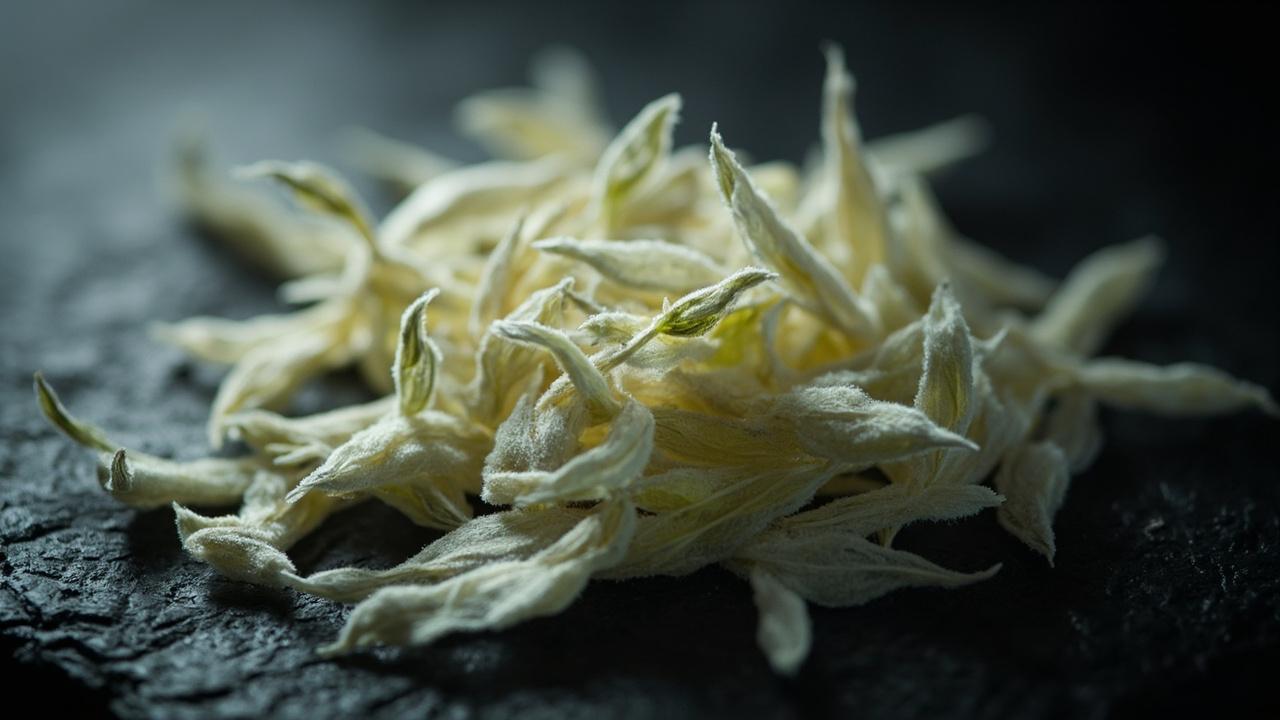
Silver Needle — Baihao Yinzhen (白毫银针), literally “White Hair Silver Needle” — is China’s highest-grade white tea, made from nothing but downy spring buds plucked in a brief early-spring window. This guide covers origin, flavor, grades, brewing, and how to pick your first tin. If you’re new to white tea, start here before exploring other tea varieties.
What Is Silver Needle?
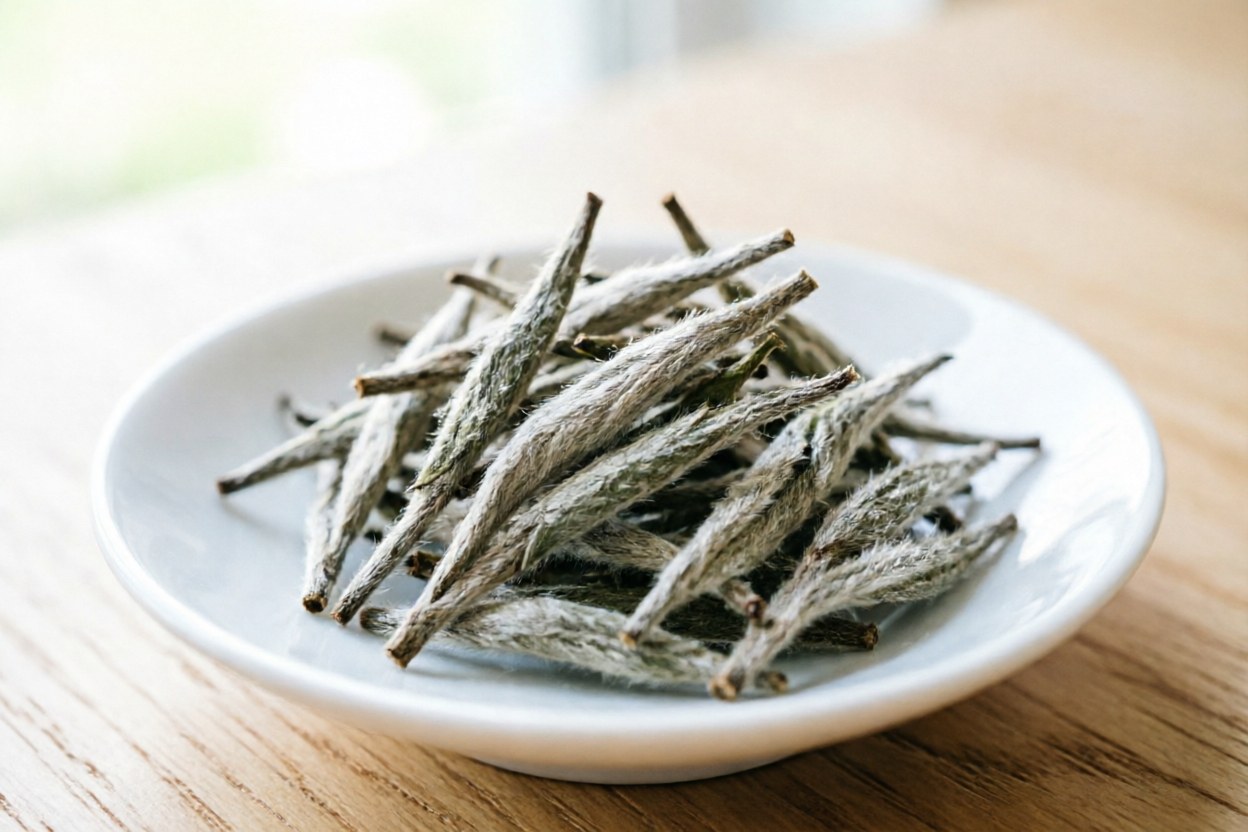
Silver Needle comes exclusively from bud-only material — the tender, unopened leaf tips covered in silvery-white down called baihao. No leaves, no stems. Just buds [1].
Two production zones define the tea, both in Fujian province:
- Fuding (福鼎) — the dominant style. Sun-withering produces lighter, sweeter buds with a honeydew-forward profile. Most Silver Needle sold outside China is Fuding-origin.
- Zhenghe (政和) — heavier withering and a longer indoor dry. The buds look darker and taste slightly smokier, with a nuttier edge [1].
Harvest runs from late March to mid-April — a brief early-spring window. Pickers hand-pluck each bud individually before the leaf opens. That narrow window is why authentic Silver Needle commands a premium over other white teas.
A newer variant has emerged from Yunnan province in recent years. Yunnan Silver Needle uses a different cultivar (large-leaf Dayeh) and produces a bolder, less downy cup. It’s real white tea, but it’s not traditional Fuding or Zhenghe — and the price usually reflects that [1]. The full price-gap breakdown is in Yunnan vs Fujian Silver Needle below.
Flavor Profile
The cup tastes delicate and sweet, but “delicate” doesn’t mean flavorless. Good Silver Needle delivers distinct notes:
- Honeydew melon — the dominant sweet fruit note
- Cucumber water — a fresh, clean vegetal quality
- Gentle floral — a soft lily or jasmine whisper on the finish
The mouthfeel sets Silver Needle apart from every other Chinese tea. It’s smooth, almost silky, with a slight viscosity from the bud oils. Astringency and bitterness stay remarkably low — this is the gentlest cup in the Chinese tea family [1].
The aftertaste is what tea drinkers call hui gan (回甘) — a returning sweetness that builds minutes after you swallow. The liquor itself runs pale champagne to light apricot. Use a white porcelain cup or glass to appreciate how subtle the color is.
Compared to Bai Mu Dan (White Peony), Silver Needle is lighter and sweeter. Bai Mu Dan includes leaves alongside buds, giving it a fuller, more full-bodied body. If Bai Mu Dan is a speaking voice, Silver Needle is a whisper you have to lean in for.
How Silver Needle Is Made
White tea’s defining trait is minimal processing — and Silver Needle takes that to the extreme [1].
Two steps, nothing more:
- Withering — fresh buds dry in sun or indoor air for up to several days. Moisture drops slowly while flavor compounds concentrate.
- Drying — a low-temperature bake locks the buds in their final state.
That’s it. No oxidation (unlike black or oolong tea). No rolling or shaping (unlike green tea). No pan-firing. The buds leave the bush looking almost the same as when they entered the package — just drier [1].
China’s national standard for white tea defines the craft the same way: the process steps it names for Baihao Yinzhen are withering (萎凋), drying (干燥), and sorting (拣剔) [5].
This minimal intervention preserves the natural baihao down and the delicate aromatic compounds inside each bud. It’s also why Silver Needle demands careful brewing: there’s no processing to hide behind. Good leaf and good water are the whole recipe.
The Fuding method leans on sun-withering, which produces lighter, sweeter buds. Zhenghe uses heavier withering, sometimes with a light rolling step, yielding darker buds and a more aromatic cup [1].
Silver Needle Grades
Not every bag labeled “Silver Needle” is the same tea. Grades shift by harvest timing, origin, and bud purity.
Harvest grades
- Toumiao (头采, “first harvest”) — the earliest spring buds, plucked in the first days of the window. Most prized, most downy, highest price.
- Yuzi (玉子, “jade seeds”) — slightly later harvest. Still bud-only but less downy coverage and a touch less sweet.
Authentic Silver Needle is 100% buds. Some lower grades mix in small leaves to bulk up the weight — those aren’t true Baihao Yinzhen, regardless of what the label says.
Price tiers
| Tier | Price range | What you get | Good pick |
|---|---|---|---|
| Budget | $12–15 | Yunnan-origin or blended | FullChea Yunnan Silver Needle · TEARELAE Bai Hao Yin Zhen |
| Mid-range | $25–40 | Solid Fuding everyday quality | Tea & Trumpets USDA Organic · Tealyra Fujian 110g · GOARTEA Supreme |
| Premium | $40–90+ | First-flush Fuding, hand-sorted | Tealyra Premium Fujian · Davidson’s 16oz bulk |
Label reading
Look for three things on the package: “Fuding” or “Zhenghe” as the origin, “Baihao Yinzhen” (not just “white tea”), and a harvest year. Bags that say only “white tea” with no origin or year are usually blended or stale.
Aged Silver Needle
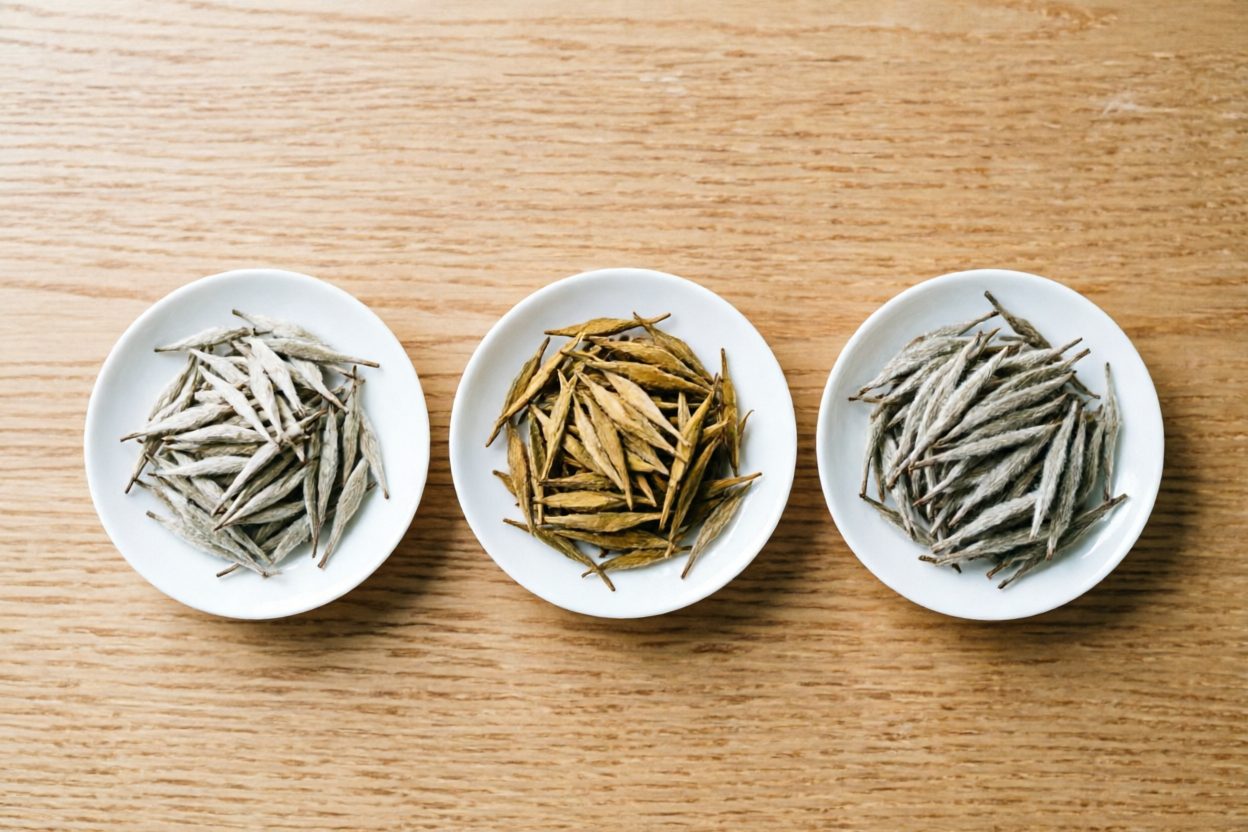
In China, aged white tea is a category of its own — lao bai cha (老白茶, “old white tea”) — and aged Silver Needle sits at its top end. Drinking fresh dominates the first two years; attention shifts at three, when florals give way to honey, and again past seven, when the cup turns dense and syrupy. Aged-tea research backs the direction: white teas undergo significant transformations in composition and flavor during storage, and storage conditions shape how far the changes go [4].
Unlike green tea (which goes stale within a year), white tea ages well. Silver Needle stored properly (sealed, dry, dark) develops deeper flavors over 1-3 years:
- Fresh (0-6 months): Floral, light, honeyed. The classic silver needle profile.
- 1 year: Slightly fuller body. The floral notes mellow; a nuttier sweetness emerges.
- 3 years: Noticeably richer. The liquor darkens from pale yellow to deep gold, and the sweetness leans toward honey and dried fruit.
- 7+ years: “Aged white tea” territory. The flavor shifts toward medicinal/herbal. Some collectors age silver needle for 10+ years.
This aging potential makes Silver Needle one of the few teas worth buying in quantity. A 100g tin stored properly gives you a fresh-drinking tea now and a richer tea in two years — same leaves, different cup. See our teaware care guide for proper storage methods.
The cheap way in is a split tin: TODICAMP Premium Silver Needle 3oz is sized for it — drink half fresh, cellar the rest airtight, light-proof, and away from odors, then taste it again in year three.
Yunnan vs Fujian Silver Needle
Why does one bag of “Silver Needle” cost $13 and another $45? Start with the cultivar. The national standard is explicit: Baihao Yinzhen is made from single buds of the Dabai or Shuixian cultivars — the bushes traditional to Fuding and Zhenghe [5]. Yunnan Silver Needle comes from the large-leaf Dayeh varietal instead, worked the same bud-only way. Same craft, different plant stock: roughly $12.99 for a 71g Yunnan tin versus about $42.99 for a 220g premium Fuding bag [7].
Neither side is fake. Fujian leaf is the orthodox reference — more down, gentler sweetness. Yunnan leaf runs bolder and less downy, and it takes cold brewing well. To taste the Yunnan side, NASLAPH Bai Hao Yin Zhen comes in a 3.53oz tin labeled for cold brewing.
How to Brew Silver Needle
I keep my kettle at 80°C for Silver Needle — the opposite of green tea. Low temperature, long steep. Boiling water scorches the buds and kills the sweetness [2].
Parameters
| Method | Leaf | Water temp | Steep time | Re-steeps |
|---|---|---|---|---|
| Gongfu (gaiwan) | 3–5g per 150ml | 75–85°C (167–185°F) | 30–60s, increasing | 4–6 |
| Western (mug) | 2–3g per 250ml | 80°C (176°F) | 2–3 min | 2–3 |
Step-by-step (Western method)
- Warm your vessel with a splash of hot water, then discard.
- Add 2–3g of Silver Needle buds.
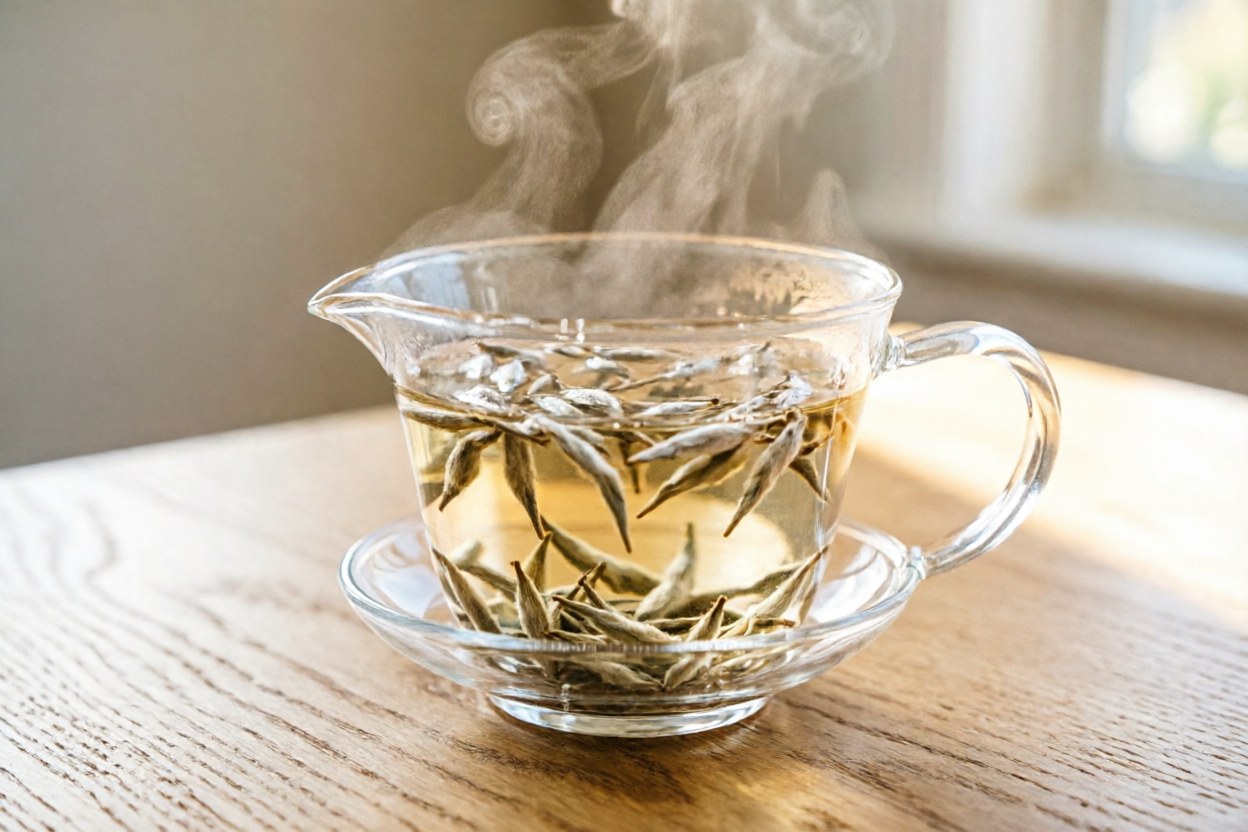
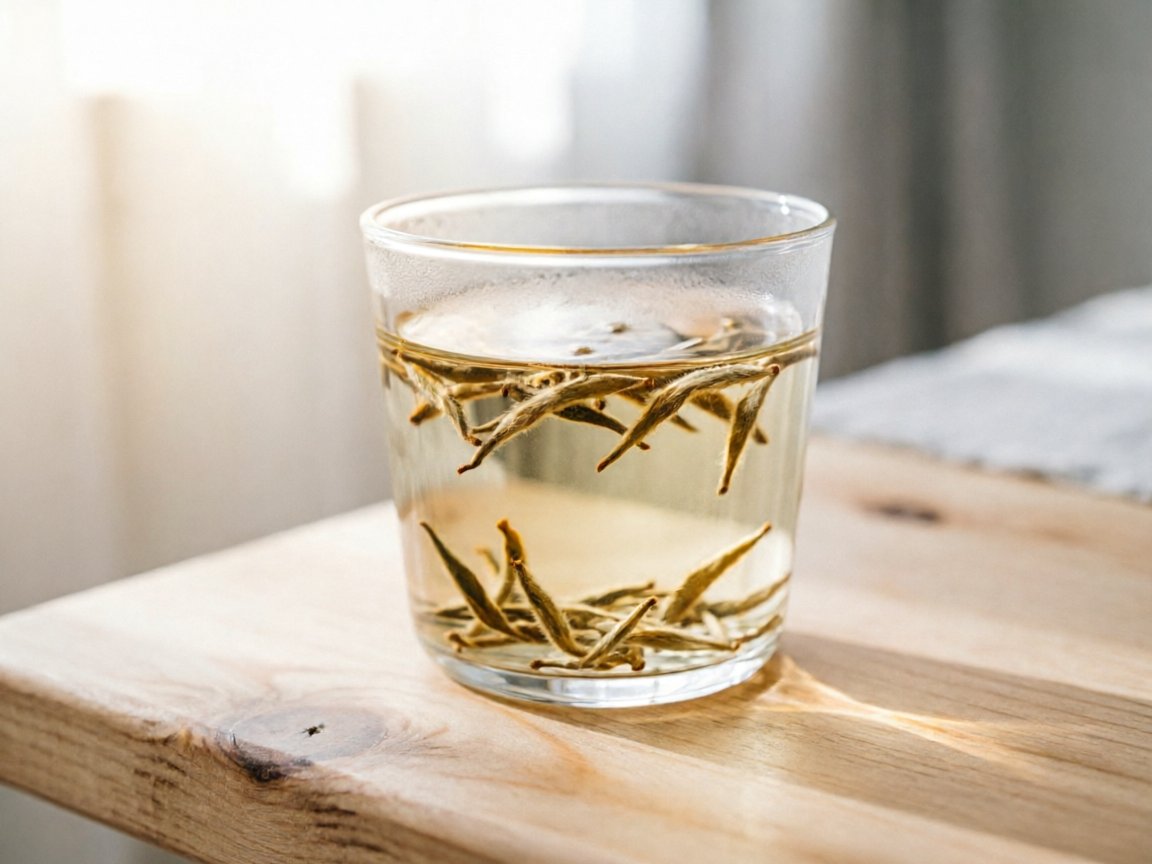
- Pour 250ml water at 80°C and steep 2–3 minutes, until the buds sink to the bottom.
- Pour through a strainer. Re-steep 2–3 more times, adding 30–60 seconds each round.
A Woonsoon glass gaiwan is the ideal vessel — you can watch the silvery buds slowly unfurl and drift downward as they steep. That visual is half the experience.
Cold brew
Drop 5g of buds into 500ml cold water and refrigerate 6–8 hours. The result is smooth, sweet, and remarkably refreshing on a warm afternoon — no bitterness, no astringency. Yunnan leaf takes to this especially well — NASLAPH Silver Needle is sized for exactly this.
Common mistakes
The number-one error is boiling water. At 100°C, the delicate bud cells rupture and release bitter tannins. Drop to 80°C and the cup transforms. If you crave a floral twist, Tealyra Jasmine Yin Zhen layers jasmine petals over Silver Needle buds for a scented alternative.
For a general brewing foundation, see how to brew tea. Use the brewing ratio tool and steeping time tool to dial in grams and minutes.
Recommended Silver Needle
All eleven picks below use the frozen ASIN pool. Prices are from the Amazon Creators API snapshot [7] and may shift.
| Pick | Best for | Price | Link |
|---|---|---|---|
| Tealyra Premium Fujian 8oz | authentic Fuding — best overall | $42.99 | B015FYRBXO |
| Tea & Trumpets USDA Organic 4oz | certified clean sourcing | $37.99 | B0872K3XQ4 |
| FullChea Yunnan 2.5oz | budget first cup | $12.99 | B0CG1N7CDS |
| TEARELAE Bai Hao Yin Zhen 4oz | everyday value | $14.99 | B09TXLZG93 |
| GOARTEA Supreme 50g | premium tasting sample | $17.98 | B013YDYBOK |
| Davidson’s 16oz bulk | daily drinker / tea club | $90.90 | B000SANUEK |
| Tealyra Jasmine Yin Zhen 4oz | jasmine-scented floral twist | $22.97 | B00ILW25YS |
| NASLAPH Yunnan 3.53oz | Yunnan origin — cold-brew friendly | $24.99 | B0GTLHSSNH |
| Tealyra Fujian 110g | mid-size tin between sample and bulk | $26.99 | B00CX2YKXG |
| TODICAMP 3oz | cellaring starter — drink half, age half | $27.99 | B0DM9PF1XQ |
| Woonsoon Glass Gaiwan 170ml | brewing vessel — watch buds dance | $17.99 | B08H1B2N9Z |
Start with a budget tin like FullChea or TEARELAE to learn the flavor, then move up to Tealyra’s Fujian-sourced premium once you can taste the difference. Between those poles, a mid-size 110g tin splits the format and a 3oz cellaring starter buys fresh cups now, aged cups later. You don’t need eight teas on day one — one good tin and a glass gaiwan are enough.
Related Varieties
Silver Needle is one stop in the wider tea world. If you enjoy its gentle profile, these sister varieties are worth exploring:
- Matcha — Japan’s stone-ground green, a completely different form but equally focused
- Longjing — China’s pan-fired Dragon Well, the most famous green tea
- Tieguanyin — Anxi rolled oolong with orchid aroma and gongfu brewing depth
- Keemun — Qimen black tea with cocoa and orchid notes
For brewing guides, start with how to brew tea or green tea brewing. Use the brewing ratio calculator and steeping time reference to dial parameters for any leaf.
Grade Comparison: Imperial vs Special vs Standard
These are Western retail labels — marketing tiers, not official grades:
| Grade | Bud purity | Harvest window | Appearance | Price range |
|---|---|---|---|---|
| Imperial (Tribute) | Bud-only | Early spring (March) | Straight, silver-white fuzz, uniform | Premium ($40-80/50g) |
| Special | Bud-dominant, occasional leaf | Mid-spring | Mostly straight, slight variation | Mid ($20-40/50g) |
| Standard | Noticeable leaf mix | Late spring | Mixed, some bent buds | Budget ($10-20/50g) |
The difference matters in the cup. Bud-only lots produce a cleaner, sweeter liquor with more body. Standard grade is still pleasant but thinner — the leaf content dilutes the bud’s honeyed sweetness. For a first taste, Special hits the sweet spot between quality and price.
The national standard doesn’t use these labels. GB/T 22291-2017 recognizes just two official tiers for Baihao Yinzhen — 特级, plump buds with thick down, and 一级, slimmer buds with lighter down [5]. “Imperial” and “Special” are seller vocabulary.
Silver Needle vs White Peony (Bai Mu Dan)
Silver Needle isn’t the only white tea. Here’s how it compares to its closest sibling:
| Feature | Silver Needle | White Peony (Bai Mu Dan) |
|---|---|---|
| Leaf | 100% buds | Bud + 2 leaves |
| Flavor | Delicate, honeyed, subtle | Fuller, nutty, more body |
| Caffeine | Varies by dose & steep, not by type | Comparable — varies by brew |
| Price | Higher | More affordable |
| Best for | Quiet tasting, connoisseurs | Daily drinking, beginners |
White Peony is the better first white tea — it’s more forgiving to brew and costs half as much. Silver Needle rewards attention; White Peony rewards frequency.
Caffeine figures here are lab-measured averages for information only [3] — actual content varies with your leaf dose, water temperature, and steep time, and is not medical advice. See our wellness information terms.
The Mind of Silver Needle
Silver Needle asks for patience. The buds are plucked in a narrow spring window and touched as little as possible — no rolling, no firing, just sun and air. When you brew them, watch how slowly they sink. The reward for waiting is a cup so gentle it seems to vanish — until the sweetness returns, quiet and persistent, like a thought you almost forgot.
References
[1] Wikipedia contributors. Baihao Yinzhen. https://en.wikipedia.org/wiki/Baihao_Yinzhen — origin (Fuding vs Zhenghe), bud-only material, withering and drying process, grades, and flavor profile.
[2] TeaVivre. Brewing Silver Needle Tea. https://www.teavivre.com/info/brewing-silver-needle-tea.html — brewing parameters (75–85°C, 3–5g/150ml gongfu ratio, steep times).
[3] Chin JM, Merves ML, Goldberger BA, Sampson-Cone A, Cone EJ. “Caffeine Content of Brewed Teas.” Journal of Analytical Toxicology. 2008;32(8):702–704. https://doi.org/10.1093/jat/32.8.702
[4] Liu Y, Yue P, Zou X, et al. “The Chemistry of Time: Flavor Evolution and Functional Health Benefits in Aged Tea.” Comprehensive Reviews in Food Science and Food Safety. 2026. https://doi.org/10.1111/1541-4337.70589 (PMC13447706)
[5] GB/T 22291-2017《白茶》(White tea). 国家质量监督检验检疫总局/国家标准化管理委员会, 2017-11-01 发布, 2018-05-01 实施. https://openstd.samr.gov.cn/bzgk/gb/newGbInfo?hcno=A87456F46DAA499E87883069D484F365
[6] Nathanson JA. “Caffeine and related methylxanthines: possible naturally occurring pesticides.” Science. 1984;226(4671):184–7. https://doi.org/10.1126/science.6207592
[7] Market data note: Amazon product pricing snapshot (PA-API), 2026-09-15 — price tiers $12.99–$90.90 across 11 SKUs in this article’s product pool.