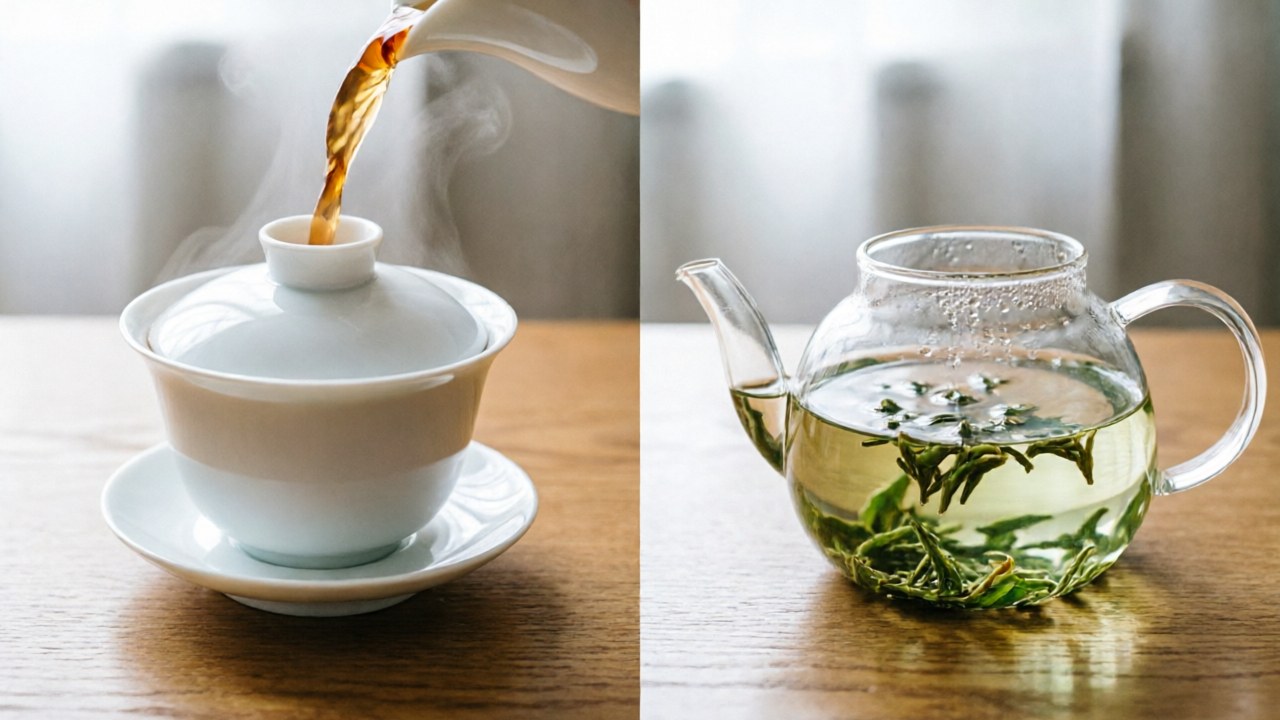
The porcelain vs glass teapot choice comes down to tradeoffs most comparison guides skip: pour control in gongfu sessions, specific steep parameters per tea type, and daily maintenance realities like chipping and thermal shock. Material science matters — but vessel geometry, lid fit, and tea-material pairing matter more. This side-by-side comparison covers heat retention, aroma release, visual experience, durability, lid fit, and which teas belong in which vessel, with actual brewing parameters instead of vague claims.
At a Glance — Quick Reference Table
| Dimension | Porcelain | Glass |
|---|---|---|
| Heat retention | High — slow cooling, holds target temp for multiple steeps | Low — drops roughly 10–15°C in the same window |
| Flavor neutrality | Fully neutral (glazed vitrified surface) | Fully neutral (inert borosilicate) |
| Visual | Opaque — judge by aroma and timing | Transparent — full leaf visibility |
| Durability | Chip-resistant, stain-resistant | Thermal-shock resistant, impact-vulnerable |
| Stovetop safe | Never | Yes — borosilicate only, low heat |
| Best teas | Black, oolong, pu-erh, dark teas | Green, white, yellow, blooming teas |
| Typical price | $15–60 | $8–60 |
Neither material adds flavor of its own — both are inert. The differences come down to thermal behavior, vessel geometry, and what each material trains you to notice. For a deeper first-vessel framework, see how to choose a gaiwan.
Material Science — Glazed Ceramic vs Borosilicate
Porcelain is kaolin clay fired at 1200–1400°C until it vitrifies — becomes glass-like and non-porous [1]. The glaze adds a smooth sealed surface that resists staining and holds no flavor memory across steeps. Wall thickness plus that vitrified mass give porcelain a high heat capacity per vessel: it cools slowly because more thermal energy is stored in the ceramic itself.
Glass teaware in the tea world almost always means borosilicate glass — the same low-thermal-expansion formula (SiO₂ with B₂O₃) used in laboratory glassware [2]. It handles sudden temperature changes well, but thin walls mean heat escapes into the room faster. Specific heat capacity of the two materials is similar, but porcelain’s thicker walls and the air trapped in glaze layers make the practical cooling rate much slower.
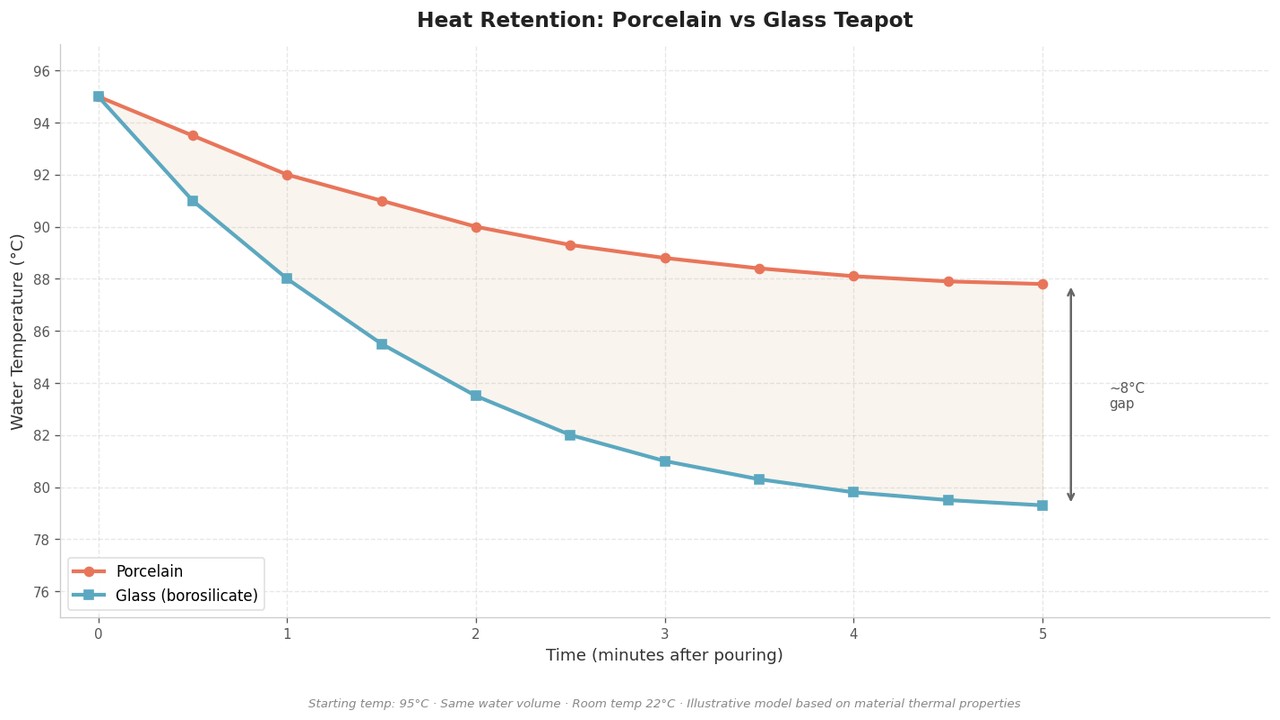
Why this matters: heat capacity determines steep temperature stability, and steep temperature determines extraction. Two vessels of the same water volume, brewed at the same starting temperature, will reach different second-steep temperatures four minutes in. That isn’t a minor detail — it changes how your oolong tastes on the third pour.
If you’re just starting out, our teaware for beginners guide walks through the first-vessel decision in more detail.
Heat Retention — The Science of Temperature
Pour 95°C water into a porcelain teapot and a glass teapot of the same volume. Five minutes later, the porcelain pot is still in the high-80s°C — well within extraction range for a second black tea steep. The glass pot has dropped into the high-70s or low-80s, which means your second steep of black, pu-erh, or roasted oolong extracts thin and flat.
For teas that need sustained 90°C+ heat — black, pu-erh, dark oolong like Da Hong Pao — heat retention is the most important factor in flavor density across multiple infusions. Glass works against you here.
For teas brewed at 75–85°C — green, white, yellow — glass’s fast cooling actually protects the leaf from over-extraction. You don’t want Longjing sitting at 85°C for four minutes; the rapid cooldown in glass is a feature, not a flaw.
The glass heat-loss workaround: double-walled borosilicate. The Teabloom Double Wall Insulated Teapot 24oz ($59.95) uses a vacuum gap to slow cooling to near-porcelain retention. If you love glass but drink slowly, this is the upgrade path. For the porcelain benchmark, the Sweese Porcelain Teapot 27oz ($29.99) holds above 85°C well past the second infusion.
For full temperature-by-tea-type parameters, see how to brew tea and the steeping time reference.
Aroma Release — Glaze Surface vs Bare Glass
Here’s where conventional wisdom gets the physics wrong. Neither glazed porcelain nor bare borosilicate glass chemically changes aroma — both are non-reactive surfaces. What changes aroma concentration is vessel geometry: lid fit, opening diameter, and how much headspace sits above the liquid.
Porcelain gaiwans are built for tight lid-on brewing — the glaze-on-glaze seal traps volatile aromatics in a narrow headspace, and lifting the lid releases a concentrated burst. Glass gaiwans, by contrast, typically have looser ground-glass lids with visible gaps; aromatics bleed out continuously rather than building under the lid.
For wider teapots, glass designs tend toward larger openings (to show leaves and accommodate blooming tea), which means more aroma surface area exposed to air. Porcelain teapots tend toward narrower spouts and lid openings — aromatics stay trapped longer.
The Porcelain Gaiwan 150ml ($11.97) is the archetype of the sealed-aroma gongfu vessel — the lid fits tight enough that the first pour smells distinctly more concentrated than the third. The Woonsoon Chinese Glass Gaiwan 170ml ($17.99) trades that sealed aroma for the ability to watch Tieguanyin leaves unfurl mid-session — a fair swap for visual learners.
For the full tasting-vessel framework, see teaware for tasting.
Visual Experience — Watching Leaves vs Elegant Form
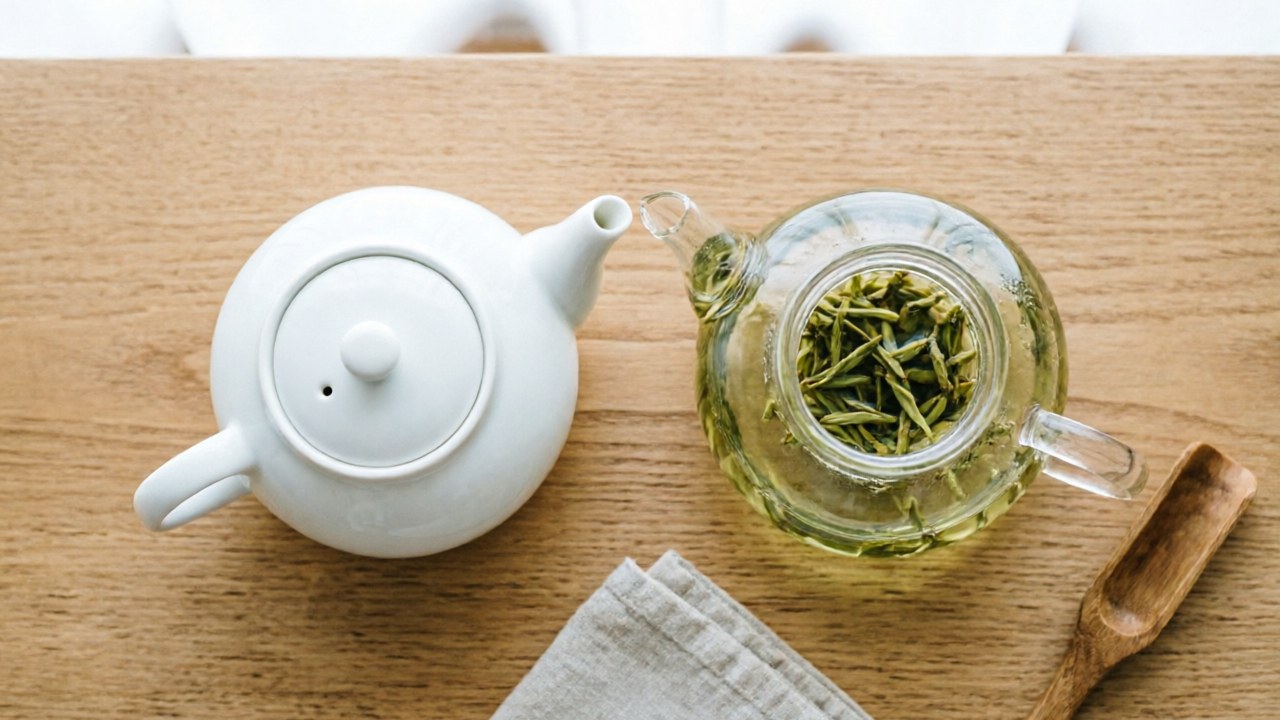
Glass rewards the eye. You see the leaves open, the liquor darken, the moment the infusion is ready by color. For green teas like Longjing, where the visual of leaves sinking and unfurling is half the experience, glass is the honest choice. For blooming and art teas, glass is the only choice — the entire product exists to be looked at.
Porcelain asks you to trust aroma, timing, and tactile feedback. You can’t see the liquor develop; you learn to read the pour’s color at the spout and the wet-leaf smell when the lid lifts. Over months of practice, this trains a brewer who is less dependent on visual confirmation and more tuned to olfactory cues.
Both approaches are valid. Glass teaches you what tea looks like when it’s done. Porcelain teaches you what tea smells and feels like when it’s done. Most experienced tea drinkers own both and reach for each in different moments.
For visual-first brewers, the HIWARE 1000ml Glass Teapot ($22.99) is the standard stovetop-safe 1L option. For blooming tea specifically, the Teabloom Stovetop Glass Teapot ($29.99) ships with blooming tea samples and a glass infuser.
Durability & Daily Maintenance
Porcelain wins on long-haul durability. A well-fired vitrified teapot resists chips, shrugs off tannin stains, and survives the dishwasher (most modern porcelain teaware is dishwasher-safe, though hand-washing the lid is gentler on the glaze). Practical lifespan with reasonable care: 10–20 years.
Glass — even borosilicate — is more fragile in a different way. It handles thermal shock (fridge to warm water) better than porcelain, but it’s more vulnerable to impact. A tap against the faucet, a spoon dropped inside, or an accumulated micro-crack from months of handling can end a glass teapot without warning. Typical lifespan: 3–10 years with daily use.
Neither material absorbs flavor. Unlike Yixing clay, which seasons and must be dedicated to one tea type, porcelain and glass can brew green tea in the morning and black tea at night with a quick rinse. Cleaning is simple: warm water and a soft cloth for both. For tannin buildup on glass (more visible than on porcelain glaze), a short soak in citric acid solution brings back the clear.
For a porcelain pick that takes daily use well, the Sweejar Royal Ceramic Teapot 28oz ($27.99) is a family-size daily driver. For budget borosilicate, the CNGLASS Glass Teapot 20.3oz ($19.99) is stovetop-safe and easy to replace. Full cleaning and storage protocols are in our teaware care guide.
Tea-by-Material Pairing Guide
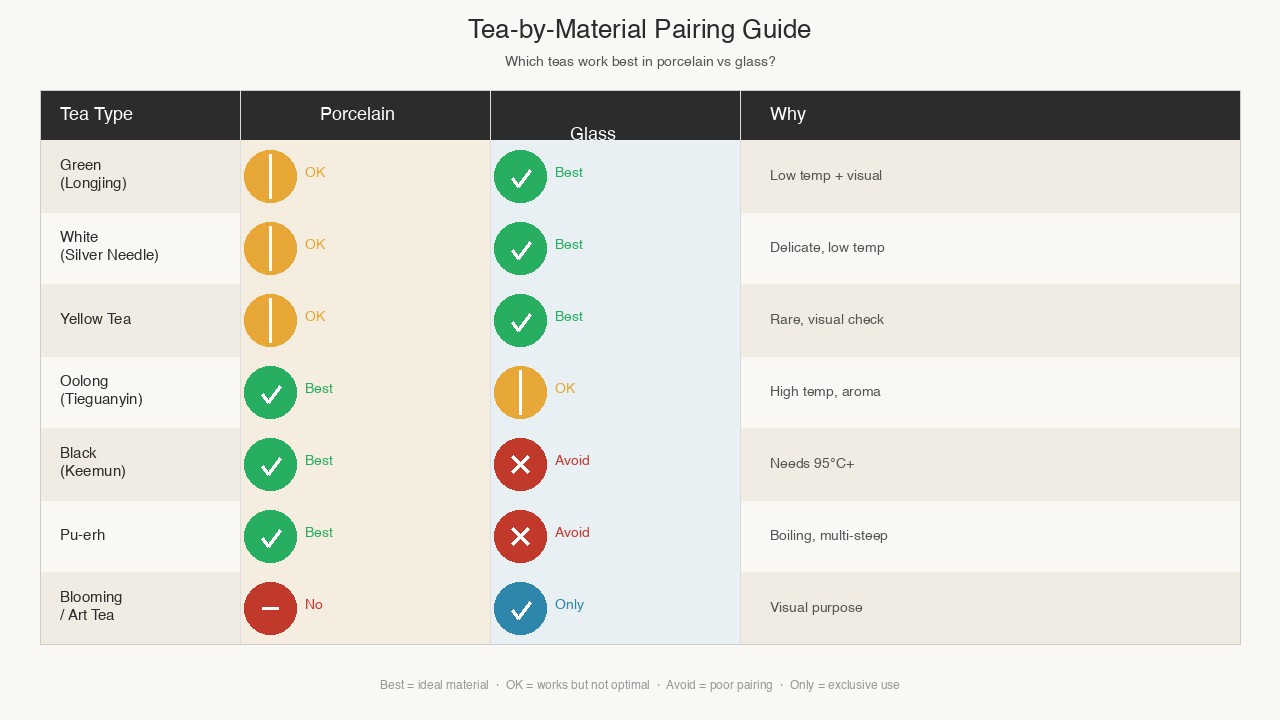
This is the practical decision matrix. Use it to match your daily teas to the right material — then pick the vessel that fits your session size.
| Tea Type | Porcelain | Glass | Why | Target Temp / Steep |
|---|---|---|---|---|
| Green (Longjing, Biluochun) | ◐ OK | ✅ Best | Lower temp + visual unfurling | 75–80°C / 1–2 min |
| White (Silver Needle) | ◐ OK | ✅ Best | Delicate, low temp | 75–85°C / 2–3 min |
| Yellow tea | ◐ OK | ✅ Best | Rare, visual inspection valuable | 80°C / 2–3 min |
| Oolong (Tieguanyin, Da Hong Pao) | ✅ Best | ◐ OK | High temp, aroma concentration | 95°C / 30–60 sec |
| Black (Keemun, Dianhong) | ✅ Best | ❌ Avoid | Needs sustained 95°C heat | 95°C / 2–3 min |
| Pu-erh (sheng/shou) | ✅ Best | ❌ Avoid | Boiling temp, multi-infusion | 95–100°C / 15–30 sec |
| Blooming / art tea | ❌ No | ✅ Only | Entire purpose is visual | 85°C / 3–5 min |
For delicate greens and whites, the Mini Glass Teapot 550ml ($7.99) is a compact solo vessel that cools fast enough to protect the leaf. For gongfu oolong and black, the Woonsoon Jingdezhen Porcelain Gaiwan 200ml ($14.99) is the handmade high-temp workhorse. For western-style black tea, the Sweese Porcelain Teapot 27oz ($29.99) holds heat for the full 3-minute steep.
Brewing ratios live in the brewing ratio calculator; matcha is a separate track entirely (chasen and chawan, not teapots).
Lid Fit & Pour Quality
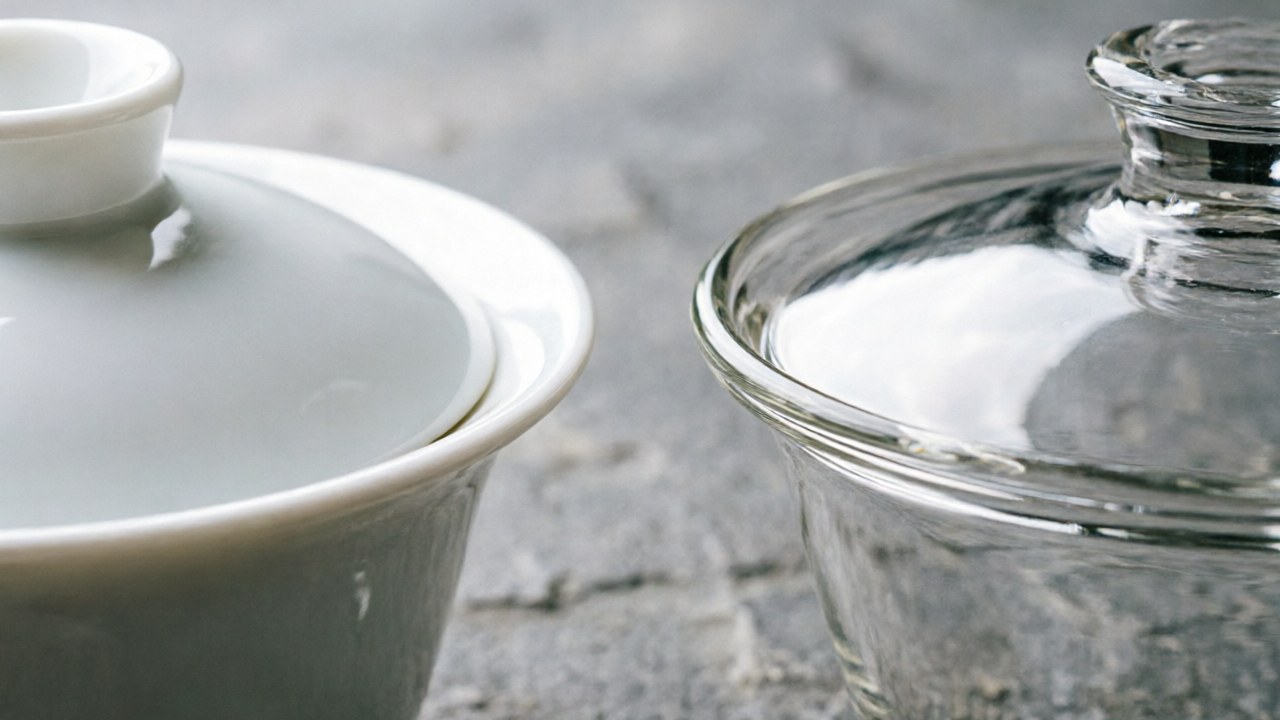
This is the section no competitor writes, and it’s the one that matters most for gongfu brewing.
Porcelain gaiwans are precision-ground at the lid rim — the glaze creates a tight rotational seal. Tilt the gaiwan to pour, and the lid stays put; the tea exits the spout in a controlled arc. Decanting a 150ml gaiwan takes about 3 seconds, which means you can stop extraction at the exact second you intend.
Glass gaiwans cannot match this. Glass can’t be precision-ground the way fired glaze can — ground-glass lids have micro-variations and looser fits. Tilt a glass gaiwan, and the lid may wobble or sit slightly off-center. Pour speed stretches to 5–7 seconds, and the last few milliliters may dribble rather than pour cleanly.
For casual brewing, the difference is invisible. For precision gongfu — where 3 seconds vs 7 seconds changes how the fifth infusion tastes — porcelain’s tighter seal is non-negotiable. This is why traditional gongfu practice standardized on porcelain.
If you’re serious about pour control, the Porcelain Gaiwan 150ml ($11.97) is the tightest lid fit at entry price. For a glass gaiwan that works for visual green-tea sessions (where pour precision matters less), the Eplze Crystal Glass Gaiwan ($10.50) is the budget option. The full lid-fit primer lives in how to choose a gaiwan.
Side-by-Side Picks — Porcelain vs Glass at Every Price
Two parallel lists. Pick from whichever side matches your daily teas.
Porcelain side
| Vessel | Volume | Price | Best for |
|---|---|---|---|
| Porcelain Gaiwan 150ml | 150ml | $11.97 | Entry gongfu, tight lid seal |
| Woonsoon Jingdezhen Gaiwan 200ml | 200ml | $14.99 | Handmade sancai upgrade |
| Sweese Porcelain Teapot 27oz | 800ml | $29.99 | Daily western-style pot |
| Sweejar Royal Ceramic Teapot 28oz | 828ml | $27.99 | Family-size alternative |
Glass side
| Vessel | Volume | Price | Best for |
|---|---|---|---|
| Mini Glass Teapot 550ml | 550ml | $7.99 | Solo budget, green/white |
| PARACITY Glass Teapot 18.6oz | 550ml | $9.99 | Travel borosilicate |
| Eplze Crystal Glass Gaiwan | 150ml | $10.50 | Budget glass gongfu |
| CNGLASS Glass Teapot 20.3oz | 600ml | $19.99 | Budget stovetop |
| Woonsoon Glass Gaiwan 170ml | 170ml | $17.99 | Visual gongfu vessel |
| HIWARE 1000ml Glass Teapot | 1000ml | $22.99 | Best-value 1L |
| Teabloom Stovetop Glass Teapot | 1100ml | $29.99 | Blooming-ready premium |
| Teabloom Double Wall 24oz | 710ml | $59.95 | Solves glass heat loss |
For a first-vessel buying path, see teaware for beginners.
Common Mistakes When Choosing
Five mistakes we see again and again:
- Buying glass for pu-erh or dark oolong. Heat drops too fast for sustained 95°C+ extraction. Use porcelain for teas that need to stay hot — the Sweese Porcelain Teapot 27oz ($29.99) is a reliable daily choice.
- Putting porcelain on the stove. Porcelain teapots are never stovetop-safe. Preheat water in a kettle, then pour.
- Choosing a glass gaiwan for precision gongfu. The looser lid means pour control suffers. Porcelain gaiwans exist for a reason.
- Ignoring double-wall glass for slow drinking. If your tea goes cold before you finish, the Teabloom Double Wall 24oz ($59.95) solves it.
- Assuming all ceramic = porcelain. Stoneware and earthenware are ceramic but porous — they absorb flavor. Look for “vitrified” or “porcelain” on the label.
For cup-specific guidance — rim shape, wall thickness, and how vessel size affects tasting — see how to choose a tea cup.
The Mind of Porcelain and Glass
Porcelain holds heat and guards aroma — it asks you to trust your nose and your timer, not your eyes. Glass lets you watch the leaf dance, trading sustained warmth for transparency. Neither is better; each teaches a different attention. Choose the one that matches the tea in front of you, not the shelf behind you.
References
[1] “Porcelain,” Wikipedia, https://en.wikipedia.org/wiki/Porcelain [2] “Borosilicate Glass,” Wikipedia, https://en.wikipedia.org/wiki/Borosilicate_glass