Among true teas, green tea carries the most L-theanine — roughly 6.6 mg per gram of dry leaf, against about 5.1 mg/g for black tea — and shade-grown varieties like gyokuro and matcha sit at the top of the green tea family, because shading slows the conversion of theanine into catechins [1][2]. How much lands in your cup then shifts with brewing temperature, steeping time, and leaf-to-water ratio. If you’ve ever wondered how much tea adds up to a meaningful dose of this amino acid, or why shade-grown teas pack more of it, this guide walks through the numbers, the science of shading, and a simple leaf calculator.
L-theanine is an amino acid found almost exclusively in Camellia sinensis — the tea plant. It’s the molecule many people point to when explaining tea’s reputation for calm focus, though the research picture is more nuanced than headlines suggest. For a broader view, our tea wellness collection covers caffeine, antioxidants, and mindful practice.
What the Research Says
L-theanine isn’t unique to tea by accident. The tea plant synthesizes it in its roots and transports it to the leaves, where sunlight gradually converts it into catechins — the astringent compounds that give green tea its dry edge [2]. This conversion is why shade-grown teas (gyokuro, matcha, kabusecha) carry more theanine: blocking sunlight slows the conversion, preserving the amino acid.
The foundational research on L-theanine and relaxation dates to Juneja and colleagues, who documented its presence in green tea and its association with alpha brain wave activity — the pattern linked to a relaxed-but-awake state [2]. A later review by Camfield and Stough examined the combined effects of L-theanine and caffeine on cognition and mood, finding that the pairing improved attention more than caffeine alone [3]. Tea delivers both molecules together, which is why many people describe green tea’s alertness as smoother than coffee’s.
These findings are real, but they come with limits. The effects are subtle, individual, and the subject of ongoing research. What the data does support is a plausible mechanism: L-theanine reaches peak blood concentration roughly 30–50 minutes after drinking [3], and it co-occurs naturally with caffeine in a ratio that many find steadier than coffee alone.
It’s worth pausing on what the alpha-wave research actually measured. Juneja’s team observed changes in brain electrical activity after theanine intake in a controlled setting — not clinical anxiety outcomes [2]. The distinction matters. Alpha waves correlate with relaxed wakefulness, but that’s a description of a mental state, not a treatment result. Later work, including Camfield’s review, framed theanine-caffeine pairing more narrowly: improved performance on attention-switching tasks compared to caffeine alone [3]. These are real findings with real limits.
The honest framing: research suggests an association, not a guarantee. If you’re managing a health condition, talk to a qualified healthcare professional rather than treating tea as therapy.
L-Theanine by Tea Type — Data Table
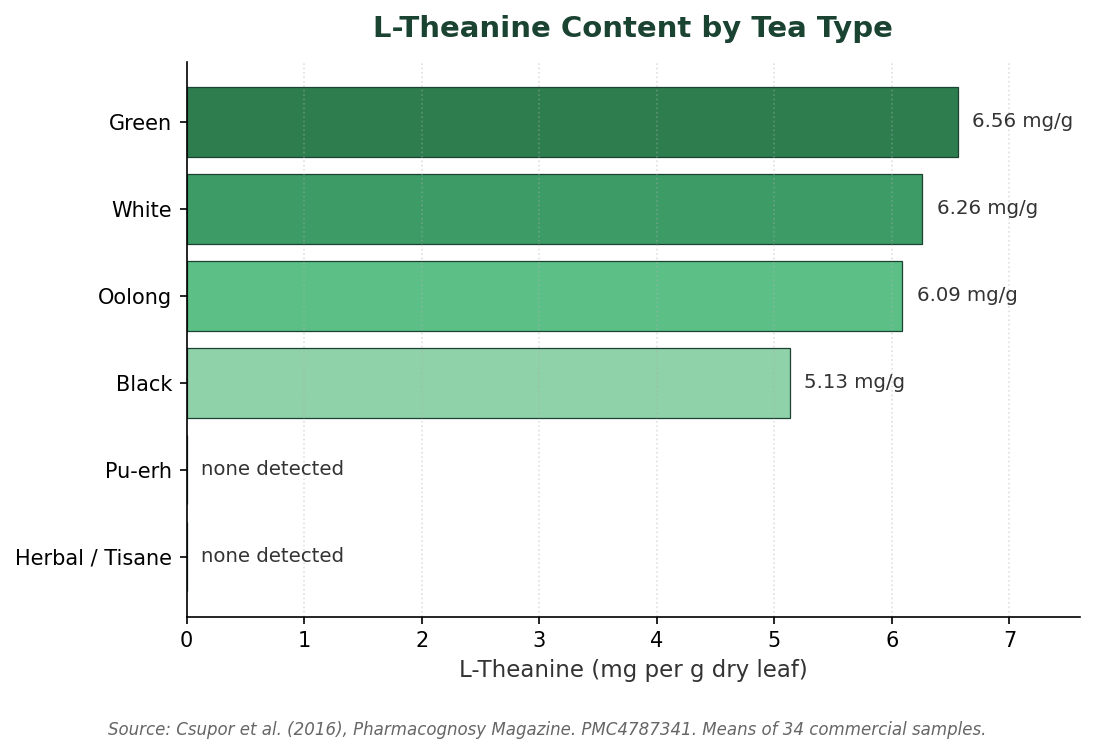
The single biggest factor in theanine content isn’t how you brew — it’s which leaf you start with. When a Hungarian research team analyzed infusions from 34 commercial teas by type, green tea came out on top, and pu-erh — fermented past the point where theanine survives — carried none at all [1]:
| Tea Type | L-Theanine (mg per g dry leaf) | Notes |
|---|---|---|
| Green | 6.56 | Highest of the types tested; shade-grown gyokuro/matcha run higher still [2] |
| White | 6.26 | Minimally processed buds |
| Oolong | 6.09 | Partially oxidized |
| Black | 5.13 | Lowest of the true teas tested |
| Pu-erh | 0 | None detected after fermentation |
| Herbal / Tisane | 0 | N/A (not Camellia sinensis) |
The type ranking is one story; the shading mechanism is another — and it’s where Japanese green teas pull ahead. The tea plant converts theanine into catechins under sunlight, so covering the bushes — gyokuro for 20+ days, kabusecha for one to two weeks — preserves more of the amino acid [2]. Matcha, made from the same shade-grown leaves but stone-ground into powder, adds a second advantage: you whisk and drink the entire leaf rather than steeping and discarding it, so nothing is left behind in the pot [4]. Precise per-cup amounts for shade-grown teas vary with cultivar, harvest, and brewing, which is why the table above reports measured per-gram averages instead of cup estimates.
If you want to test the shade-grown difference yourself, start with Ocha & Co. Organic Gyokuro ($35, 100g) for the fullest theanine cup, or the budget-friendly Asayu Gyokuro Tea Bags ($18.99, 15 bags) if you want convenience without leaving the shade-grown lane. For matcha, Naoki Matcha Superior ($24.99, 40g) is a reliable ceremonial blend. Half-shade options like Yame Kabusecha ($29.99) and Ocha & Co. Organic Kabusecha ($25.95) split the difference — more theanine than sencha, friendlier price than gyokuro.
For the caffeine side of the equation, see our caffeine by tea type reference and the matcha caffeine guide.
Variables That Change the Number — Brewing & Serving
The table gives you a starting point, but the actual amount in your cup depends on four variables. The good news: L-theanine extracts more readily than caffeine at lower temperatures [4].
Temperature. L-theanine dissolves efficiently even at 60–70°C — cooler than what most people use for green tea. This is why gyokuro tradition calls for water around 60°C. Hotter water extracts more caffeine and catechins (the bitter compounds), which is why boiling water makes green tea taste harsh without adding proportional theanine. Our water-temperature guide covers the full range.
Steeping time. Longer steeps pull more theanine into the water, though returns diminish after about three minutes [4]. A two-minute gyokuro steep at 60°C will already capture most of the available amino acid.
Leaf-to-water ratio. More leaf means more theanine per cup. Gyokuro recipes call for a high ratio — roughly 5–6 g per 100 ml — which concentrates both flavor and theanine. Standard sencha uses 2–3 g per 200 ml, which is why the numbers run lower.
Whole-leaf vs powder. Matcha is the outlier. Because you whisk the entire powdered leaf into water and drink it, there’s no extraction limit — you consume 100% of the leaf’s theanine. A 2 g serving of Matcha Konomi First-Harvest Gyokuro ($35.95) or the Naoki Matcha 100g bulk tin ($39.99) delivers the leaf’s full amino acid load.
Harvest season matters too. First-flush (spring) leaves carry more theanine than summer harvests, since the plant’s amino acid stores are richest early in the growing cycle [4]. A spring-picked gyokuro and a late-summer version from the same farm can differ noticeably in both umami depth and theanine content — one reason first-harvest teas command premium prices.
Water chemistry plays a smaller but measurable role. Softer water extracts amino acids slightly more efficiently than very hard water, which is one reason Japanese tea tradition favors naturally soft water sources [4]. If your tap water runs hard, filtered or spring water can bring out more of the sweet, savory note that signals theanine.
Practical Tips — Maximizing Theanine and a Leaf Calculator
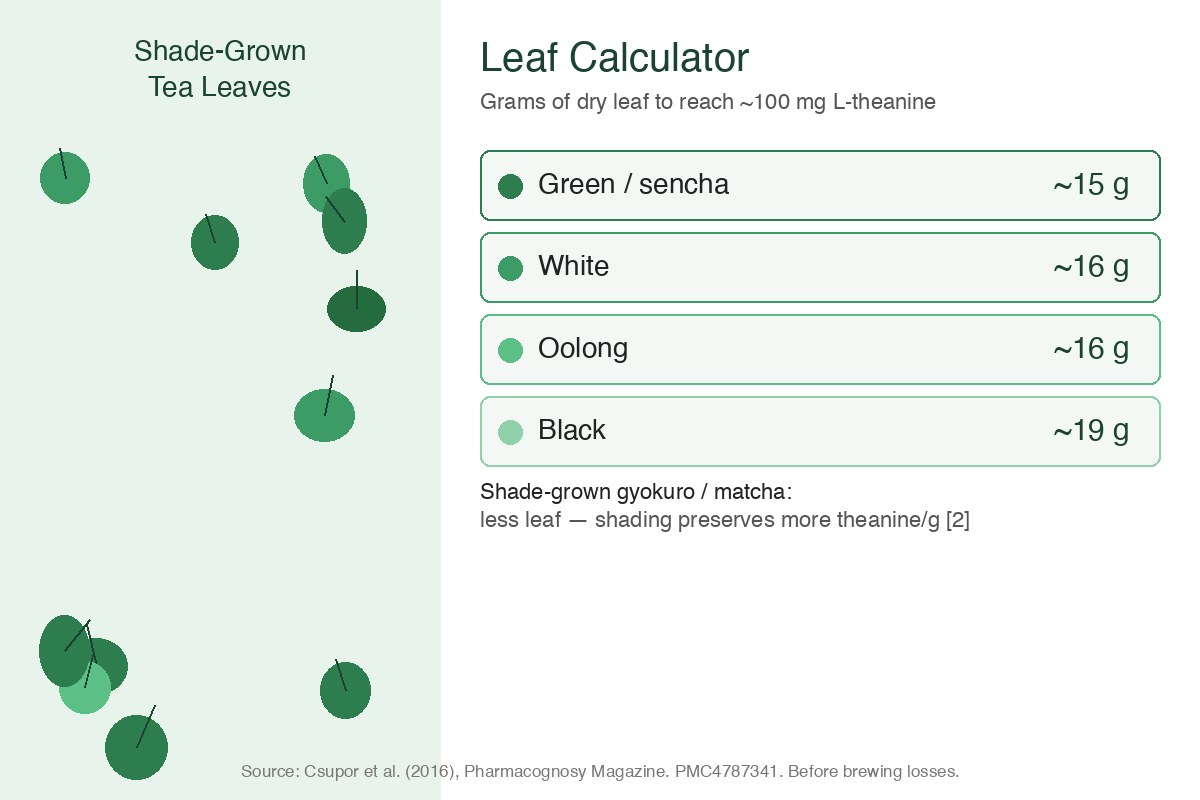
Here’s where the numbers meet your teapot. If you’re aiming for roughly 100 mg of L-theanine from tea — a level some people associate with calm focus [3] — the per-gram data above makes the arithmetic simple. Before brewing losses, 100 mg of theanine takes:
Leaf calculator (target: ~100 mg L-theanine):
- Green / sencha: ~15 g of dry leaf (6.56 mg/g)
- White: ~16 g (6.26 mg/g)
- Oolong: ~16 g (6.09 mg/g)
- Black: ~19 g (5.13 mg/g)
- Shade-grown gyokuro / matcha: less leaf, since shading preserves more theanine per gram [2]
In cup terms, a standard 2–3 g sencha serving holds roughly 13–20 mg of theanine before brewing losses, so 100 mg means several cups across the day. A gyokuro session using 5–6 g of leaf concentrates the same amino acid into two or three small cups [4].
Tea vs supplement. A 200 mg L-theanine capsule like Nutricost L-Theanine 200mg ($11.95, 120 capsules) delivers a dose that would take roughly 10–15 cups of green tea to match, before brewing losses. The difference: tea brings caffeine, catechins, and the slow ritual of brewing alongside the amino acid. Research on theanine-caffeine synergy is ongoing, but the combination is what makes tea feel different from an isolated capsule [3].
What you’ll need for a high-theanine cup:
- Shade-grown leaf: Senbird Gyokuro Isshin ($29.99) for brewed, or Jade Leaf Ceremonial Matcha ($18.99) for whisked
- A sencha baseline for comparison: YAMASAN Organic Sencha ($20.73)
- Water at 60–70°C, more leaf than usual, and 2–3 minutes of patience
Daily routine suggestion. Morning matcha for the caffeine-theanine lift, afternoon sencha for a gentler touch. If you pair tea with a mindfulness practice, our tea and meditation guide walks through a simple breath-and-sip technique.
Safe Limits, Supplements, and a Word of Caution
There’s no established upper limit for L-theanine consumed through tea — the FDA classifies it as GRAS (generally recognized as safe) as a food component. Most adults drinking several cups of green tea daily are well within any reasonable intake.
Supplements are a different conversation. Capsule doses of 100–400 mg far exceed what tea delivers naturally. If you’re considering a supplement, talk to a healthcare professional — especially if you take blood pressure medication, stimulants, or sedatives, since L-theanine may interact with these [4].
Caffeine interaction. L-theanine may smooth caffeine’s edge, but it doesn’t cancel it. An evening cup of gyokuro still delivers caffeine, which can affect sleep. Our tea and sleep guide covers timing and caffeine awareness for evening tea.
Pregnancy and medication. Standard guidance applies. Consult a qualified healthcare professional before making dietary changes if you’re pregnant, nursing, or managing a medical condition. Full policy details are at /terms/#wellness-health-information.
The Mind of the Amino Acid
L-theanine is the quiet companion to caffeine — it doesn’t shout, it steadies. Shade-grown teas like gyokuro and matcha carry the richest stores, but even a humble sencha offers enough for a gentle lift. Brew cooler, steep a touch longer, and let the leaf give what it gives. Theanine rewards attention, not optimization.
References
[1] Csupor D, Boros K, Jedlinszki N, et al. “Theanine and Caffeine Content of Infusions Prepared from Commercial Tea Samples.” Pharmacognosy Magazine. 2016;12(Suppl 4):S75–S79. https://pmc.ncbi.nlm.nih.gov/articles/PMC4787341/
[2] Juneja LR, Chu DC, Okubo T, Nagato Y, Yokogoshi H. “L-Theanine — A Unique Amino Acid of Green Tea and Its Relaxation Effect in Humans.” Trends in Food Science & Technology. 1999;10(6–7):199–204. https://doi.org/10.1016/S0924-2244(99)00044-8
[3] Camfield DA, Stough C, Farrimond JA, Scholey AB. “Acute effects of tea constituents L-theanine, caffeine, and epigallocatechin gallate on cognitive function and mood: a systematic review and meta-analysis.” Nutrition Reviews. 2014;72(8):507–522. https://doi.org/10.1111/nure.12120
[4] Vuong QV, Bowyer MC, Roach PD. “L-Theanine: Properties, Synthesis and Isolation from Tea.” Journal of the Science of Food and Agriculture. 2011;91(11):1931–1939. https://doi.org/10.1002/jsfa.4373