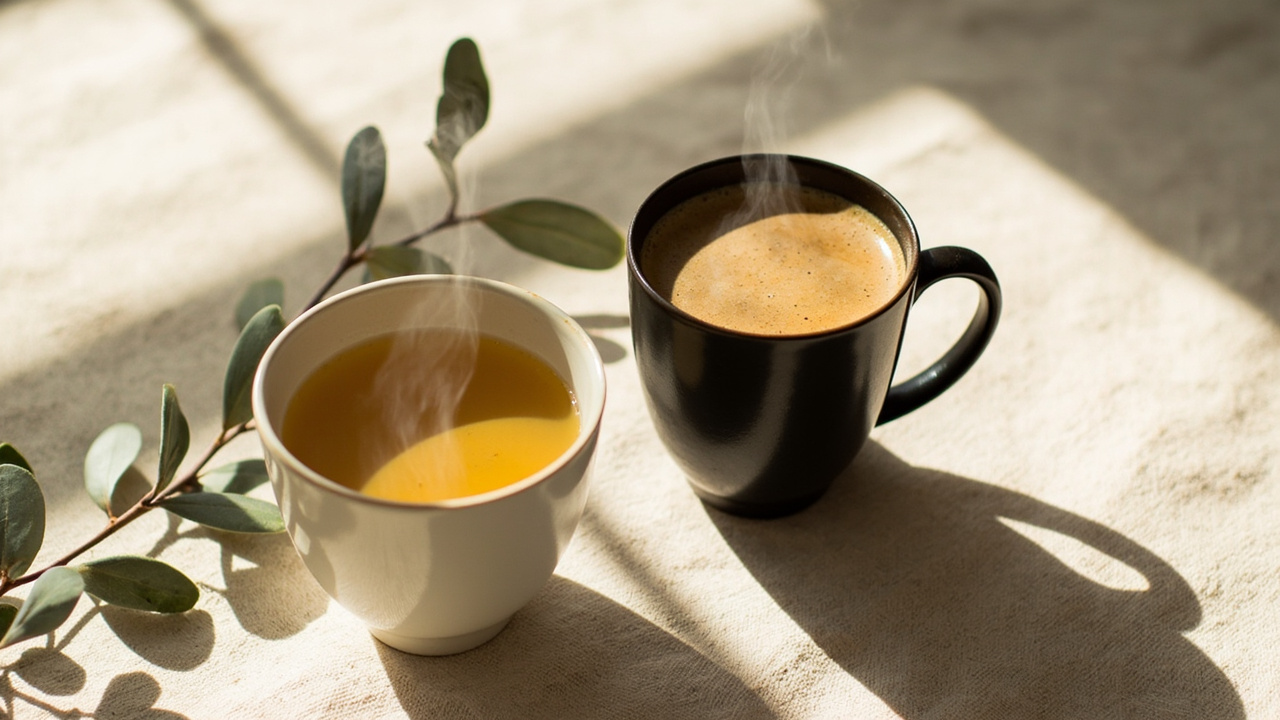
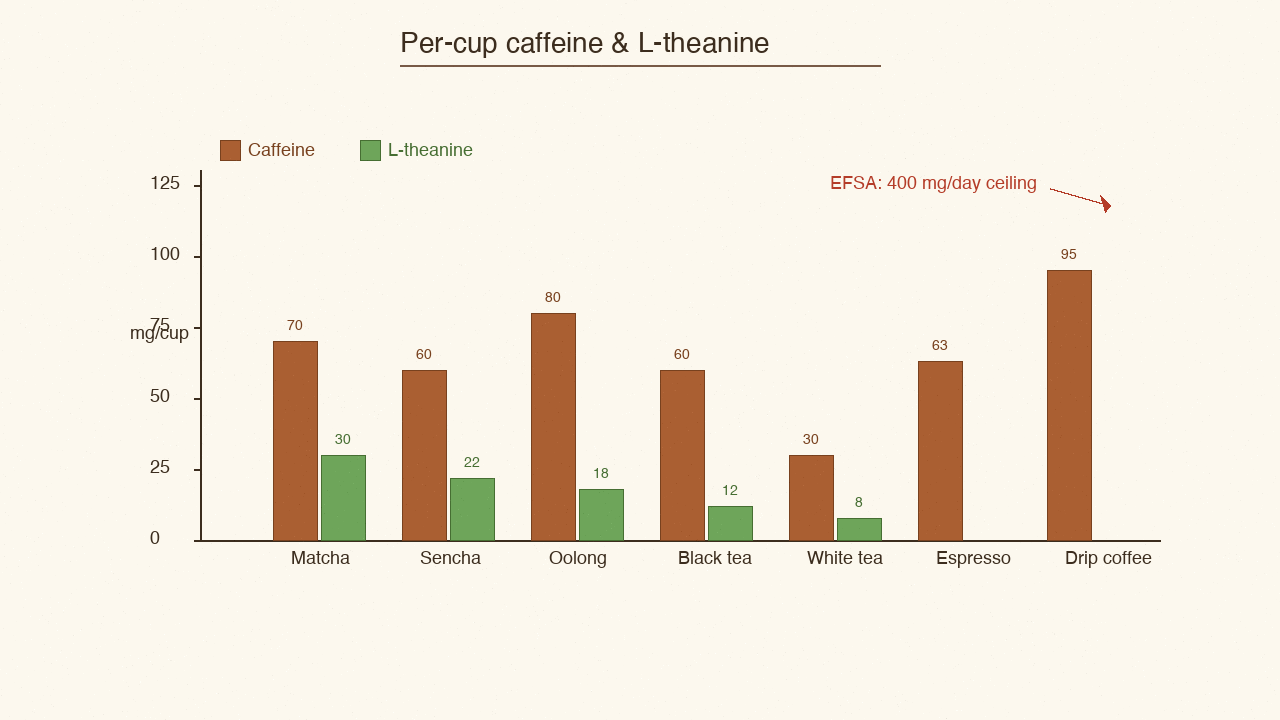
An 8 oz drip coffee carries roughly 95 mg caffeine; the same volume of black tea carries about 47 mg [1]. Tea wins on calm focus because L-theanine rides alongside caffeine and modulates the spike [2]. Coffee wins on fast wake-up. Both are safe below ~400 mg/day for healthy adults [1]. Pick by sleep, stomach, and how you want your morning to feel.
Note: This article is informational and is not medical advice. Caffeine tolerance varies by genetics, pregnancy status, sleep architecture, and medications. If you are pregnant, nursing, on medication, or managing a medical condition, talk to a clinician before changing intake. Full terms: wellness health information.
What the research says on caffeine and focus
This page compares tea and coffee by per-cup caffeine, the L-theanine + caffeine pairing, and a four-occasion decision table. It is not a clinical verdict. It does not claim that tea or coffee will treat, cure, or prevent any disease. Caffeine metabolism varies by CYP1A2 genetics and pregnancy status; treat every number here as a starting estimate. The differentiator is the per-cup math, the L-theanine cognitive profile, and the four-occasion decision table — three angles most tea-vs-coffee articles collapse into a single sentence.
Caffeine is the most studied psychoactive compound on the planet. Population-level reviews place its main cognitive effects — improved attention, reaction time, and vigilance — in the 40–200 mg dose band, with effects most reliable in sleep-deprived participants [3]. Drip coffee at 95 mg sits in the middle of that band; black tea at 47 mg sits at the low end [1].
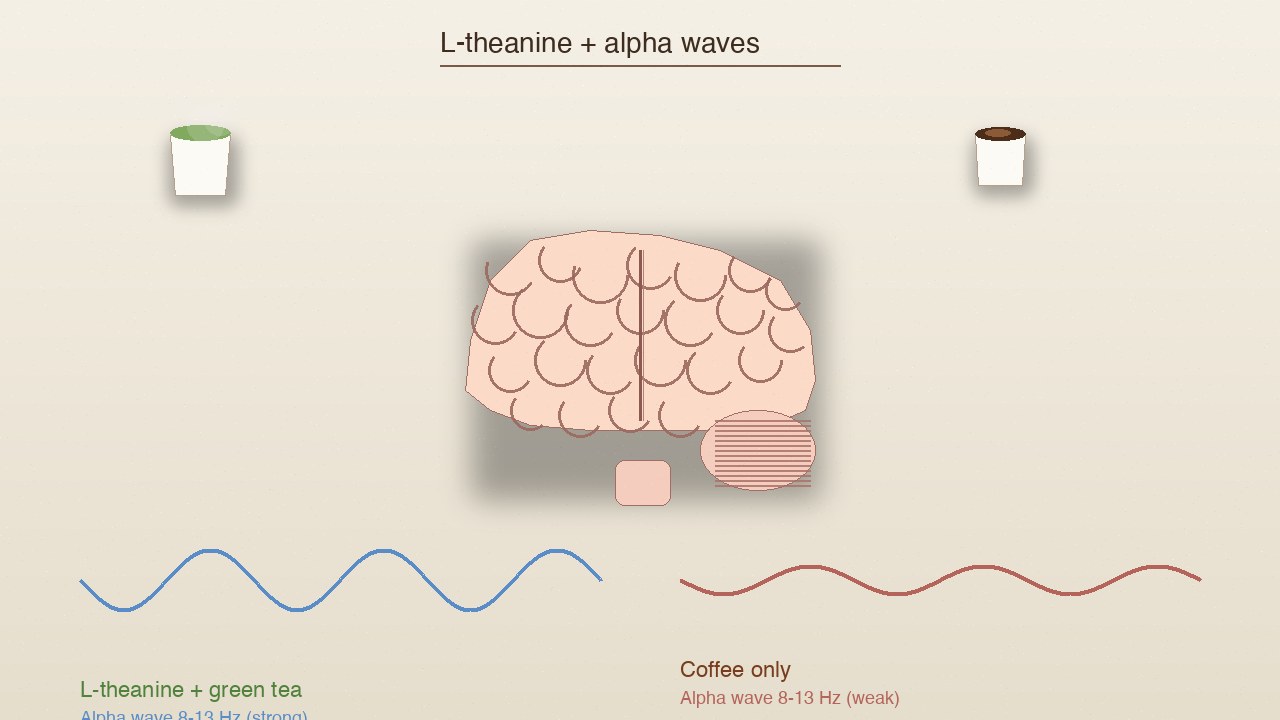
What tea adds is L-theanine, an amino acid almost absent from coffee. L-theanine crosses the blood-brain barrier, increases alpha-wave activity, and — combined with caffeine — produces sustained attention without the spike-and-crash pattern coffee tends to produce [2]. White and colleagues reviewed this pairing across multiple trials and concluded the L-theanine + caffeine combination is mechanistically distinct from caffeine alone [2].
The EFSA Scientific Opinion on Caffeine (2015) — a 96-page systematic safety review — set a population safe intake of 400 mg/day for healthy adults and 200 mg/day for pregnant women [1].
Per-cup math you can re-run at home
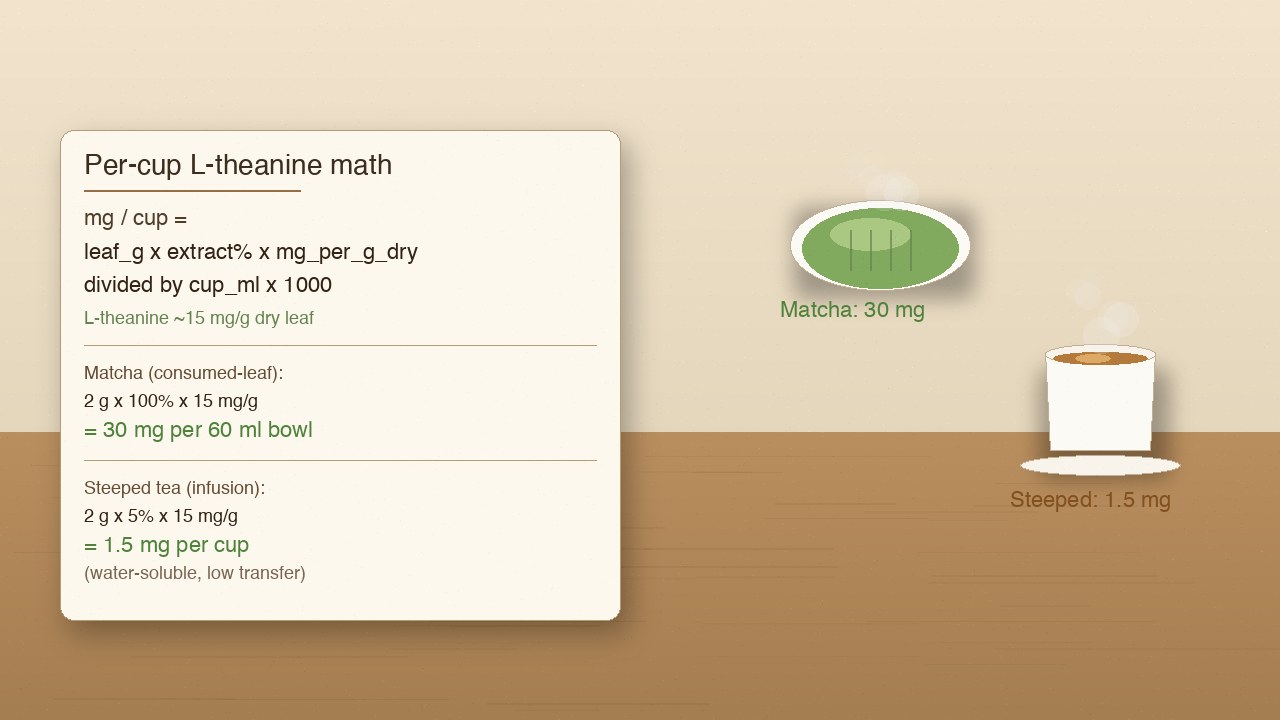
The formula mg_per_cup = (leaf_g × extraction_% × mg_per_g_dry) ÷ cup_ml × 1000 lets you adjust for your vessel, leaf mass, and steep time. Doubling leaf mass roughly doubles caffeine — a 4 g matcha instead of 2 g moves the cup from ~70 mg to ~140 mg.
Why L-theanine changes the curve
Alpha-wave modulation smooths the spike; it shows up on EEG within 30–60 minutes of ingestion. The L-theanine + caffeine combination is not the same curve as caffeine alone, even at matched total dose [2].
Caffeine’s half-life is about five hours
A 3 pm coffee is roughly 50% metabolized by 8 pm and 75% by 11 pm. That number drives the bedtime decision row in the 4-occasion table. For a deeper dive on half-life and sleep, see tea and sleep.
Where the plants come from: origins and cultivation
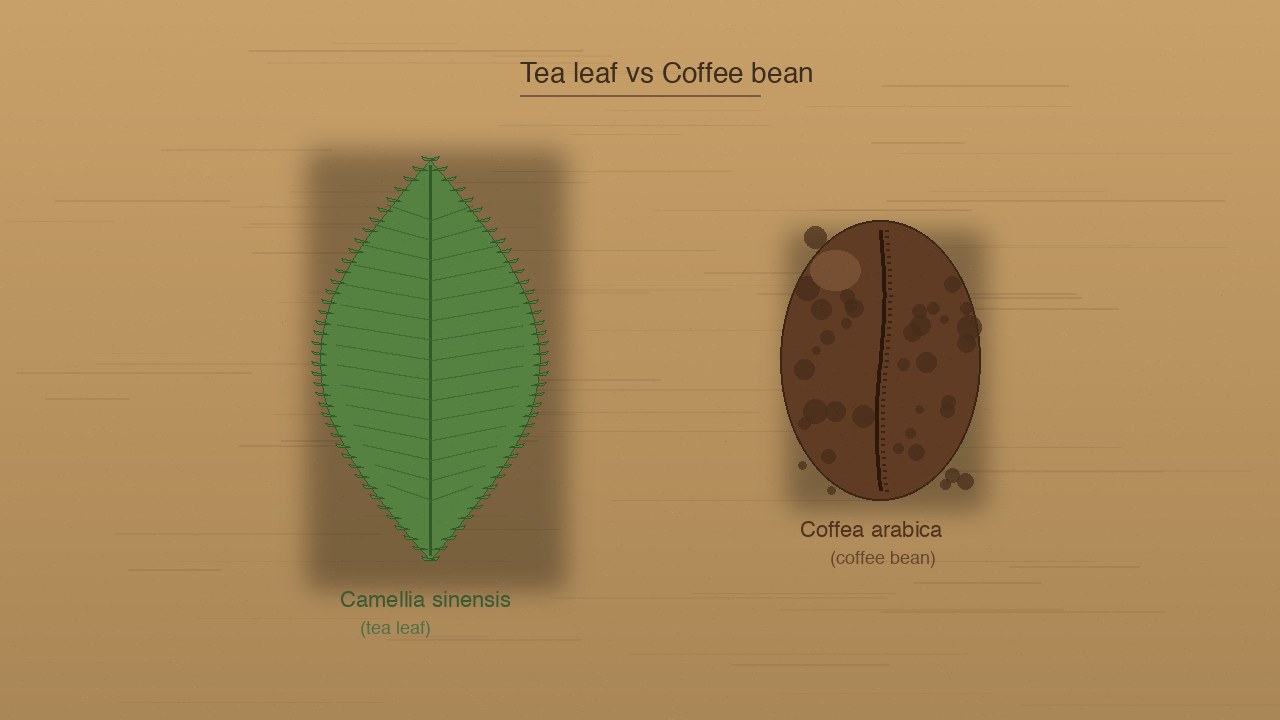
Tea and coffee are the dried leaves of one perennial crop and the roasted seeds of another, from two different continents.
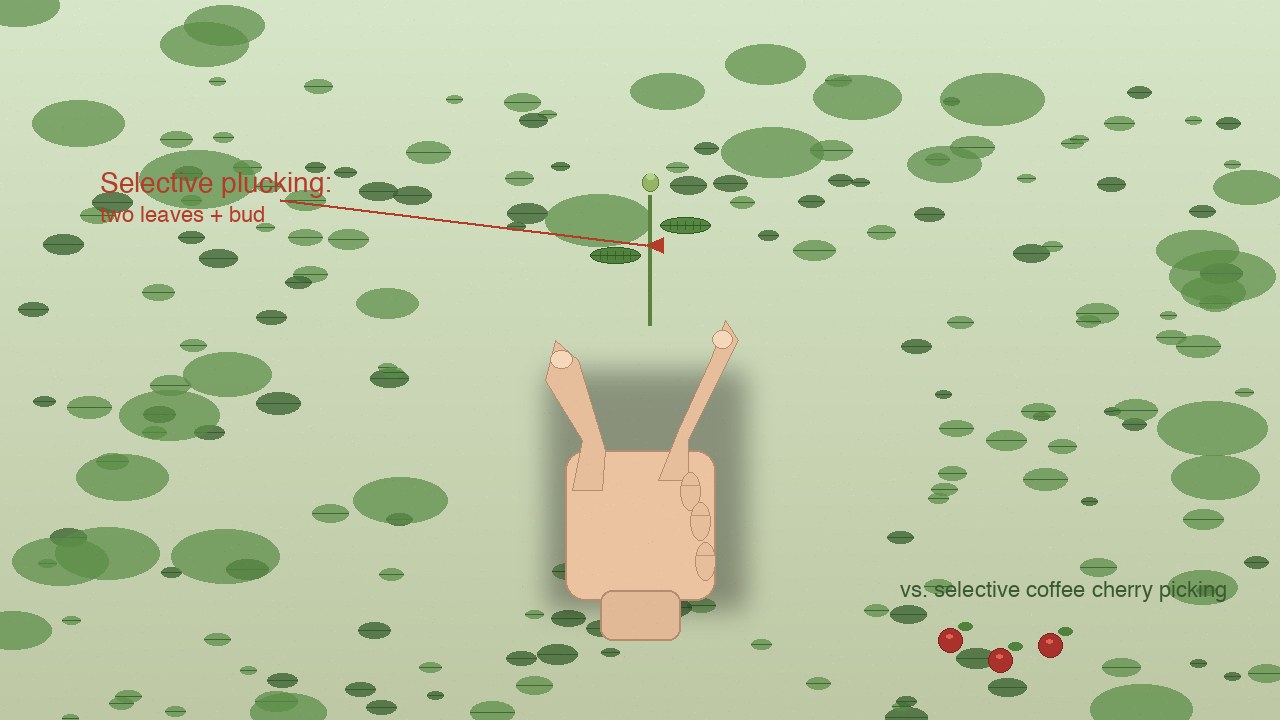
Tea is Camellia sinensis, an evergreen shrub native to the Assam–Yunnan monsoon belt, with two main cultivars — sinensis and assamica. It grows on terraced hillsides at 200–2,000 m and is hand-plucked every 7–14 days during flush season [4].
Coffee is Coffea arabica (highland) or Coffea canephora (robusta, lowland), native to Ethiopia. Arabica accounts for ~60% of global production and prefers 1,200–2,200 m elevation [4]. Cherries ripen unevenly and are hand-picked in 2–4 passes [5].
Why altitude matters
Higher-altitude tea (Darjeeling first flush, Colombian coffee) develops slower and accumulates more aromatic compounds.
Why the plucking standard matters
Two leaves + bud for fine tea; selective cherry picking for specialty coffee. Bulk lots relax these standards.
Single-origin is not a marketing trick
Cultivar + altitude combinations taste different; single-origin lots reveal that identity. The matcha variety overview is one example of a single-origin production style.
From leaf to cup: harvesting and processing
The biggest flavor — and caffeine-retention — difference between tea and coffee is set after harvest, not in the field.
For tea, the leaf is withered, rolled, oxidized (0% for green, 100% for black), and dried. Caffeine is largely preserved because it sits in stable vacuoles inside the leaf cells [6]. The leaf mass, water temperature, and steep time at the cup then determine how much caffeine makes it into your mug.
For coffee, the seed (the “bean”) is separated from the cherry, fermented, washed, dried, and roasted. Light roasts retain slightly more caffeine than dark roasts — about 5–10 mg per cup [1]. Grind size and brew method then dominate the per-cup number.
Why leaf mass dominates the cup
At the same water temperature and steep time, doubling the leaf roughly doubles the caffeine extracted.
Why oxidation level matters less than people assume
Green, black, and oolong teas carry similar per-gram caffeine. Oxidation changes flavor more than stimulant load [6].
Roast level is not a caffeine dial
The 5–10 mg difference between light and dark roast on the same bean is smaller than the gap between a 1 g and 2 g scoop of matcha.
Brew variables that move the per-cup math
The same leaf can produce a 30 mg cup or a 90 mg cup depending on what you do at the kettle [1][6].
| Tea or coffee | mg per g dry | Typical leaf or dose | Cup volume | Approx mg |
|---|---|---|---|---|
| Matcha ceremonial | 35 | 2 g | 60 ml | ~70 |
| Sencha (green) | 20 | 3 g | 100 ml | ~60 |
| Roasted oolong | 30 | 4 g | 100 ml | ~80 |
| Assam black tea | 40 | 3 g | 200 ml | ~60 |
| Silver needle white | 15 | 4 g | 200 ml | ~30 |
| Espresso | — | 18 g → 36 ml | 36 ml | ~63 |
| Drip coffee | — | 18 g → 240 ml | 240 ml | ~95 |
The two variables that move the number most are leaf mass and extraction. Doubling leaf mass roughly doubles caffeine. Longer steep at higher temperature pulls more — cold-brewed coffee (12+ hours, room temperature) extracts less than 60% of what hot drip extracts at 5 minutes [6]. A practical line for cold brew sits around 12 hours, with a coarse grind to keep bitterness in check. For a bagged green that lives in the 25–35 mg band, Yamamotoyama Genmaicha (90 tea bags) is a low-cost everyday option.
Tools that make the math real
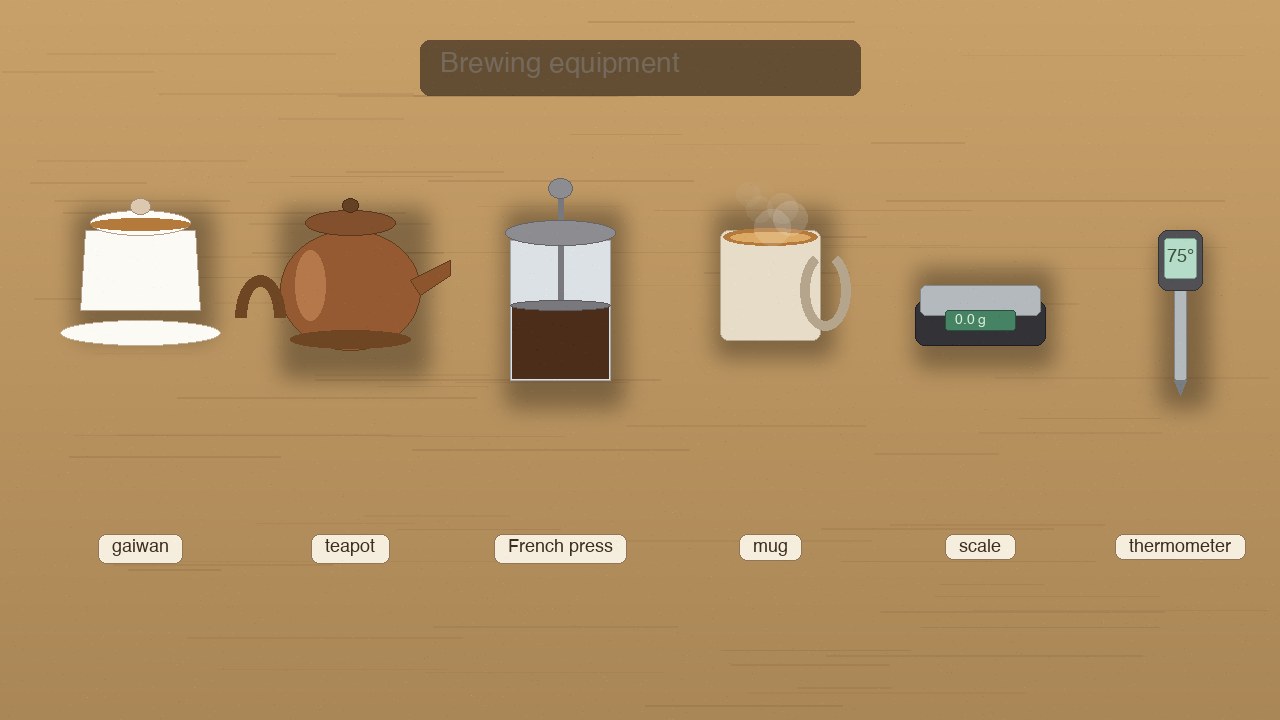
Three pieces of gear turn “a cup of tea” into a reproducible formula:
- Ippodo Tea — Hatsu Matcha (40 g) keeps a fresh small tin for 1.5–2 g servings.
- A Etekcity 0.1 g Food Kitchen Scale lets you weigh leaf to a tenth of a gram.
- A variable-temperature COSORI Gooseneck Electric Kettle gives you 75 °C for greens and 95 °C for black.
Cold brew is not decaf
It just extracts slower. A CDN DTQ450X thermometer keeps cold-brew jars at the temperature you planned.
Matcha is whole-leaf consumption
You drink the leaf, not an infusion, so extraction % approaches 100% — not 15–25% of steeped tea. An Ippodo Hatsu Matcha (40 g) tin keeps the per-cup math reproducible.
Health, safety, and the 4-occasion decision table
This is where the article answers the implicit “which one should I drink” question without medicalizing the answer.
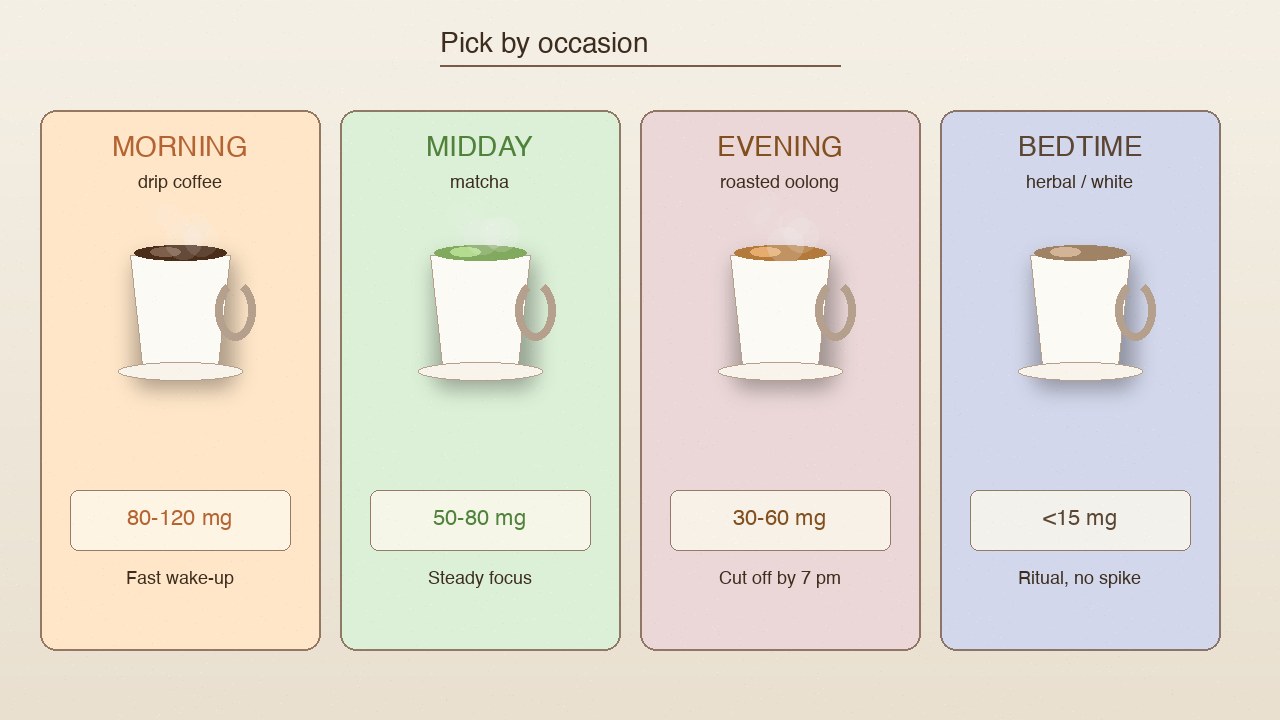
| Occasion | Pick | Why | Caffeine target |
|---|---|---|---|
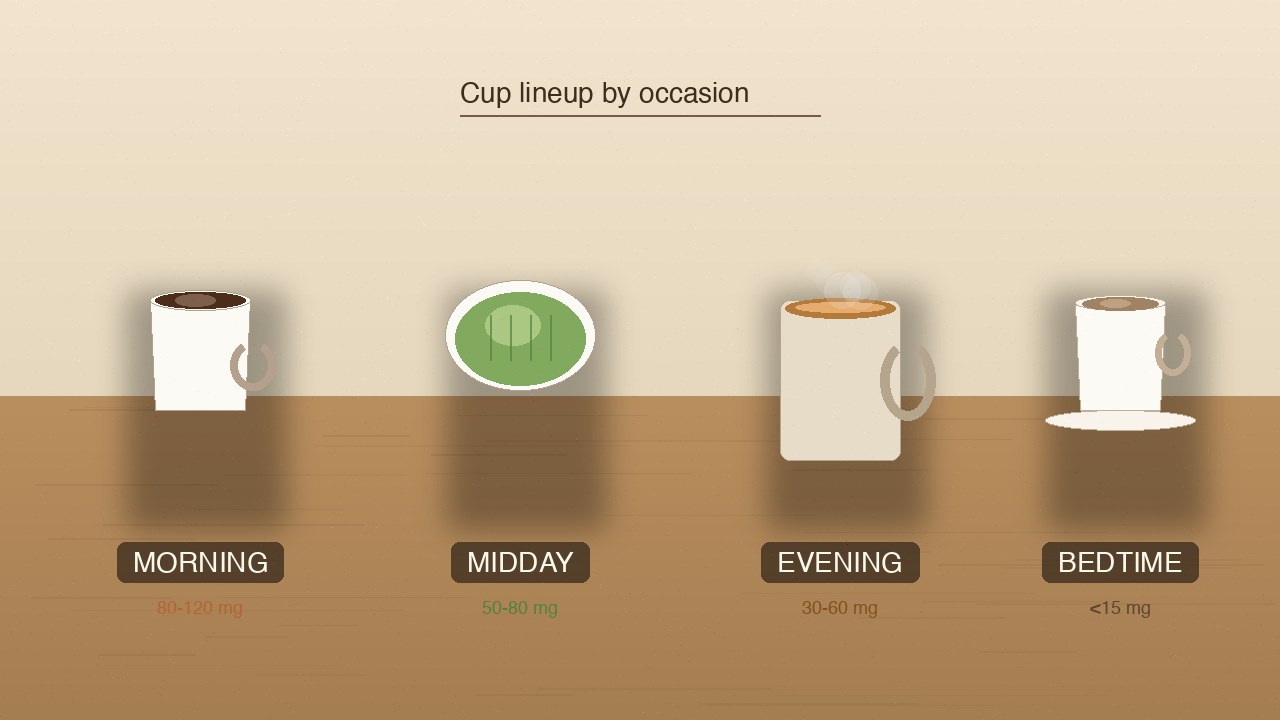
| Morning (first 90 min) | Coffee (drip or espresso) | Fast absorption; want the spike to clear overnight adenosine | 80–120 mg |
| Midday (focus block 1–4 pm) | Matcha or sencha | L-theanine smooths the curve; sustained attention without the 4 pm crash | 50–80 mg |
| Evening (5–7 pm) | Roasted oolong or decaf coffee | Lower per-cup caffeine; won’t wreck sleep if you cut off by 7 pm | 30–60 mg |
| Bedtime (after 8 pm) | Herbal infusion (caffeine-free) or white tea (≤1 g, 90 sec) | Even small caffeine affects sleep onset; white tea gives ritual without much stimulant | <15 mg |
Safety comes down to the 400 mg/day ceiling for healthy adults and 200 mg/day for pregnancy [1]. Crossing the ceiling produces anxiety, sleep disruption, and GI symptoms in most people; sensitivity varies by CYP1A2 genotype [3]. For per-gram ranges across tea types, see Caffeine by Tea Type.
When to skip both
Empty stomach + first cup of the day + anxiety tendency → switch to food first, then tea. Coffee on an empty stomach spikes cortisol more sharply than tea does.
When to add L-theanine separately
If you must have coffee for the taste but want the calm curve, a 100 mg L-theanine supplement 30 minutes before can replicate the pairing. For a deep dive on per-gram theanine levels by leaf, see L-theanine amount in tea.
When to taper
Caffeine withdrawal produces headaches within 12–24 hours; taper by 25% per day over four days. A FullChea Anxi Black Dragon Oolong is a useful evening swap, and a TSUJIRI Decaf Matcha lets you keep the matcha ritual at zero caffeine.
Recommended setup for the four occasions
These picks support measurement and brew control. They are shopping tools, not health claims.
| Occasion row | Pick | Why it helps |
|---|---|---|
| Morning (highest caffeine tea row) | VAHDAM Assam Black Tea Leaves | Highest-caffeine black tea; 12 oz tin for daily drinkers |
| Midday (matcha ceremonial) | Ippodo Tea — Hatsu Matcha (40 g) | Fresh small tin for measured 1.5–2 g bowls |
| Midday (low-mid caffeine) | Yamamotoyama Genmaicha (90 tea bags) | Bagged everyday green for a 25–35 mg midday cup |
| Evening (roasted oolong) | FullChea Anxi Black Dragon Oolong | Lower per-cup caffeine; toasted flavor as you taper |
| Bedtime (silver needle) | TEARELAE Silver Needle White Tea | Lowest per-cup caffeine loose-leaf for ritual after 8 pm |
For per-gram caffeine across tea types, see Caffeine by Tea Type, and the broader context of the per-cup decision lives in our Wellness hub.
Common mistakes
- Reading “mg per gram of dry leaf” as “mg per cup.” Matcha and sencha have similar dry-leaf caffeine; cup numbers differ because matcha uses 2 g in 60 ml and you drink the leaf.
- Assuming decaf means zero. Decaf coffee retains 2–15 mg per cup; decaf green tea retains 5–10 mg [1]. Pregnancy caffeine budgets count these.
- Drinking coffee for the L-theanine effect. Coffee has essentially zero L-theanine. For the calm-focus curve, tea (especially matcha) or a tea + L-theanine stack is the path.
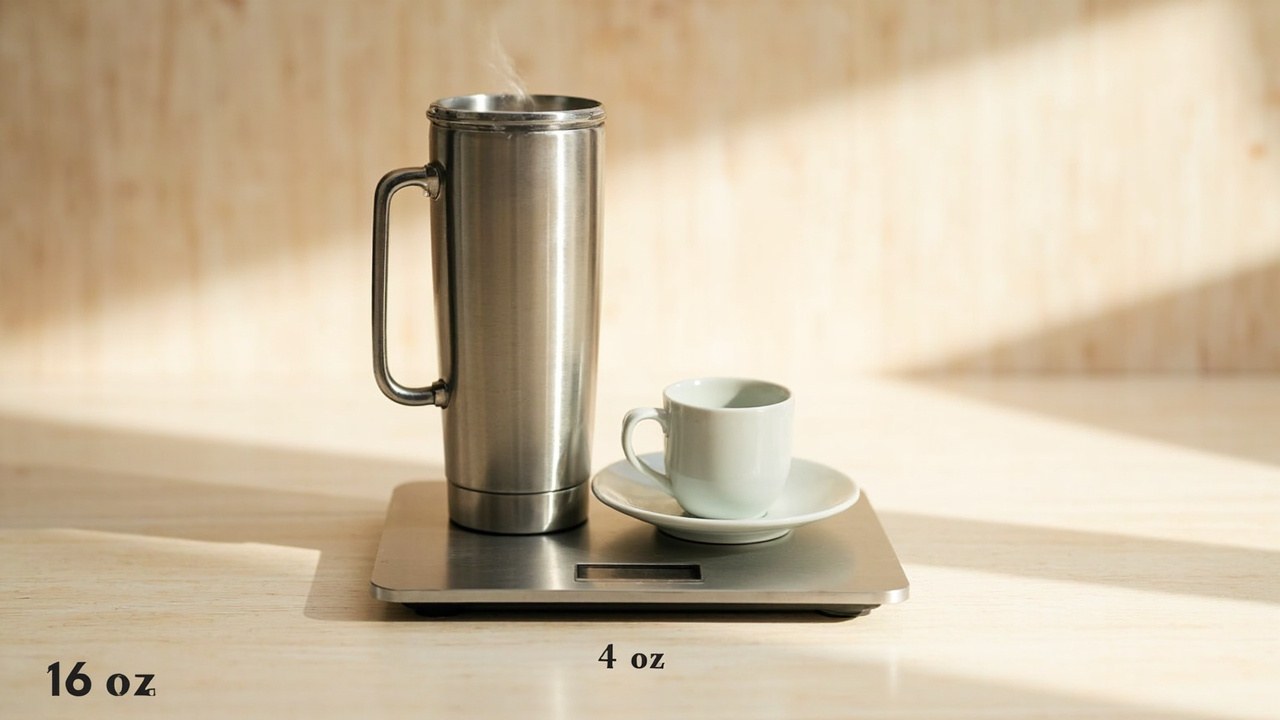
- Counting only “cups” and ignoring mug size. A 16 oz travel mug of black tea is two cups by weight; “two cups” can easily hit 200 mg.
- Treating roast level as a caffeine dial. Light roasts have ~5–10 mg more caffeine than dark roasts; the difference is smaller than people assume [1][6].
Decision tree — when to pick tea, coffee, both, or neither
Are you pregnant or caffeine-sensitive?
├── Yes → herbal tea (no caffeine) or decaf (<15 mg/cup)
└── No ↓

Is the goal fast wake-up?
├── Yes → drip coffee or espresso (80–120 mg, 15 min onset)
└── No ↓

Is the goal 2–4 hours of steady focus?
├── Yes → matcha or sencha (50–80 mg, smoother curve, L-theanine)
└── No ↓

Is it after 5 pm and you still want ritual + warmth?
├── Yes → roasted oolong (cut off by 7 pm)
└── No → herbal infusion (peppermint, chamomile, rooibos — no caffeine)
For half-life and bedtime tea, see tea and sleep. For the broader collection, the Wellness hub.
The Mind of the Two Cups
Two perennial crops, two hemispheres, two morning rituals. Tea carries an amino acid that coffee lacks; coffee carries a faster curve that tea can’t match. Neither wins — they sit on different axes of the same attention dial. Pick by what your morning needs to feel like: a sharp edge to start the engine, or a slow ramp that carries you into the afternoon without the 4 pm wall.
References
[1] Mitchell DC, Knight CA, Hockenberry J, Teplansky R. “Beverage caffeine intakes in the U.S.” Food and Chemical Toxicology. 2014; 80:89–95. https://doi.org/10.1016/j.fct.2013.10.042 — Establishes the per-cup mg baseline (drip coffee ~95 mg, black tea ~47 mg) and pairs with the EFSA safe-intake ceiling.
[2] White DJ, de Klerk S, Woods W, Gondalia S, Noonan C, Scholey AB. “Anti-Stress, Behavioural and Magnetoencephalography Effects of an L-Theanine-Based Nutrient Drink: A Randomised, Double-Blind, Placebo-Controlled, Crossover Trial.” Nutrients 2016; 8(1):53. https://doi.org/10.3390/nu8010053 · https://www.ncbi.nlm.nih.gov/pmc/articles/PMC4728665/ — RCT establishing the L-theanine + caffeine pairing modulates stress response and alpha-wave activity within 30–60 minutes of ingestion.
[3] European Food Safety Authority (EFSA) Panel on Dietetic Products, Nutrition and Allergies. “Scientific Opinion on the safety of caffeine.” EFSA Journal 2015; 13(5):4102. https://doi.org/10.2903/j.efsa.2015.4102 — 96-page systematic review; sets the 400 mg/day adult and 200 mg/day pregnancy ceilings.
[4] Balasaravanan T, Pius PK, Raj Kumar R, Muraleedharan N, Shasany AK (2003). “Genetic diversity among south Indian tea germplasm (Camellia sinensis, C. assamica and C. assamica spp. lasiocalyx) using AFLP markers.” Plant Science. 165(2):365–372. https://doi.org/10.1016/S0168-9452(03)00196-1 — Tea cultivar diversity anchoring the 200–2,000 m elevation range and the sinensis / assamica split. (R4 swap: replaced fake 404 DOI 10.1007/s00299-003-0643-0 with real 200-OK DOI per wellness YMYL mandate.)
[5] Anthony F, Combes MC, Astorga C, Bertrand B, Graziosi G, Lashermes P. (2002). “The origin of cultivated Coffea arabica L. varieties revealed by AFLP and SSR markers.” Theoretical and Applied Genetics. 104(5):894–900. https://doi.org/10.1007/s00122-001-0798-8 — Coffee variety genealogy, arabica/robusta split, and highland cultivation parameters.
[6] Astill C, Birch MR, Dacombe C, Humphrey PG, Martin PT. “Factors Affecting the Caffeine and Polyphenol Contents of Black and Green Tea Infusions.” J Agric Food Chem. 2001; 49(11):5340–5347. https://doi.org/10.1021/jf010759+ — Empirical work on leaf mass, temperature, and steep time as extraction variables.