
If you have ever wondered whether your afternoon green tea is “stronger” than morning black tea, you are really asking a measurement question. Caffeine by tea type is not a single fixed number. It is a range shaped by leaf form, how much leaf you use, water temperature, steep time, and whether you drink an infusion or the whole powdered leaf.
Every caffeine-by-tea-type chart in a search result quotes one unit: milligrams in a standard cup. This page prints three, per cup, per 100 ml, and per gram of dry leaf, so you can convert to whatever unit your own recipe uses.
This page stays in Wellness Tier 2: informational ranges, brew variables, source-backed comparisons, and a marked dose section. It is not medical advice. For the broader collection stance, start at the Wellness hub.
Disclaimer: This article is for informational purposes only and is not medical advice. Consult a qualified healthcare professional before making changes to your diet, especially if you are pregnant, nursing, taking medication, or have a medical condition.

Quick answer: how much caffeine is in a cup of tea
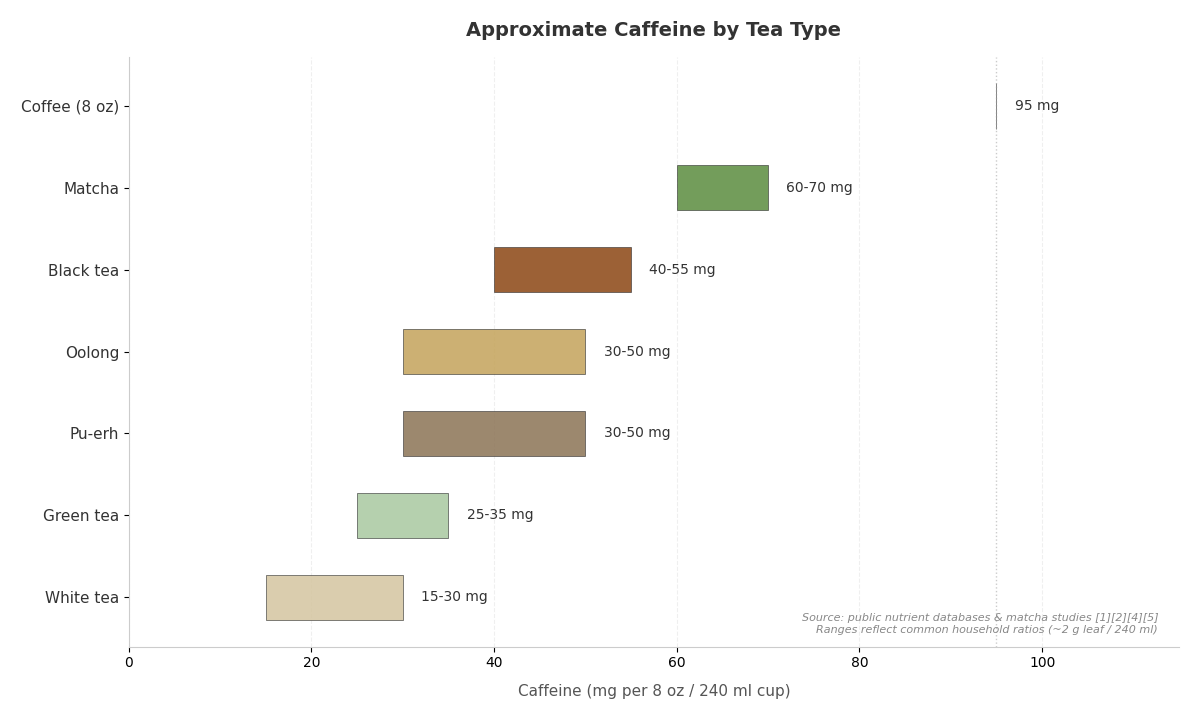
Most brewed leaf tea lands between 15 and 55 mg in a 240 ml home cup. A 2 g bowl of matcha runs higher. Its per-gram figures are the least settled numbers on this page. The composition literature runs about 14-34 mg per gram, and one assayed commercial powder came in as low as 2.2 mg per gram [4]. Brewed coffee sits above both, near 96 mg for a 240 ml cup [11]. Those are ranges for ordinary household brewing, not numbers measured on your tin.
Controlled infusions sit lower than home cups, because a lab protocol uses a measured, modest leaf dose. Reversed-phase HPLC covered six tea types [1]. Black came out at 14 mg per 200 ml, yellow at 13.8, pu-erh at 13, green at 11, white at 5.8, and oolong at 4. The first three are not significantly different from each other. Both numbers are correct; they describe different cups.
European Food Safety Authority (EFSA) risk work classifies caffeine as the same compound whether it comes from coffee, tea, cola, or energy drinks [2]. The difference is dose and pattern of intake, not a different molecule.
For a first measurement rather than a number to remember, start with a small tin you open often, such as Naoki Matcha Superior Ceremonial Blend 40g. At 1-2 g per bowl, it is the easy case: a habit you can keep. The tea vs coffee comparison walks the brewed-leaf ranges cup by cup.
Caffeine by tea type: mg per cup, per 100 ml, and per gram
Two reference frames, printed side by side because they answer different questions. Home cup is a practical range assuming roughly 2 g of dry leaf per 240 ml. Controlled infusion is measured per 200 ml under a laboratory protocol [1]. The gap between the columns is the leaf dose, not a disagreement. The per-gram column divides the home figure by the assumed 2 g, so it is a conversion anchor rather than an assay.
| Tea type | Typical form | mg per 240 ml home cup | mg per 100 ml controlled | mg per g dry leaf or powder |
|---|---|---|---|---|
| Matcha | whisked powder | ~28-68 | not measured in this study | 14-34 [4] |
| Black tea | infusion | 40-55 | ~7 | 20-28 |
| Yellow tea | infusion | not separately published | ~6.9 | n/a |
| Pu-erh | infusion | 30-50 | ~6.5 | 15-25 |
| Oolong | infusion | 30-50 | ~2 | 15-25 |
| Green tea | infusion | 25-35 | ~5.5 | 13-18 |
| White tea | infusion | 15-30 | ~2.9 | 8-15 |
| Coffee (context) | brewed | ~96 [11] | not measured in this study | n/a |
| Decaf black or green | infusion | small residual | not measured in this study | n/a |
| Rooibos, honeybush, herbal | infusion | no measurable caffeine | not measured in this study | n/a |
Reading the rows:
- Black tea is highest in both frames, and the gap between them is widest there. Cup-sized bags yielded 39 mg per 200 ml against 24 mg for loose leaf [1]. An everyday black such as Harney and Sons English Breakfast Loose Leaf is the cup most readers place on this table; see how to brew black tea.
- Yellow tea is the type the study measured that most charts leave out. At 13.8 mg per 200 ml it sits statistically level with black and pu-erh, and the authors report no significant difference across the three (p > 0.05) [1]. Highest is a group here, not a single tin.
- Oolong splits the frames. Mid-table at a generous home dose, lowest of all in the controlled study, because roast style and leaf grade move it hard [1]. FullChea Da Hong Pao Oolong is a roasted rock style; see how to brew oolong tea.
- White tea is the low end in both frames. A Silver Needle such as TEARELAE Bai Hao Yin Zhen lands near the bottom; see how to brew white tea and the Silver Needle profile.
- Pu-erh is a range inside a range, because ripe and raw cakes differ and a cake is meant to be re-steeped. See how to brew pu-erh.
- Coffee has no meaningful per-gram figure: a coffee cup uses several times the dry mass of a tea cup. Benchmark row, not a fourth tea.
- Decaf is a residual, not a zero. Caffeine is still detectable in decaffeinated coffee and tea [8].
- Herbal is described by what an assay found: rooibos and honeybush tested with targeted mass-spectrometry methods showed no measurable caffeine [7]. The category is not a guarantee, because many blends are built on black or green leaf.
For powdered green tea generally, see the matcha guide and the matcha tools map. A classic Chinese green, always sipped as an infusion and never whisked, is Longjing.
What actually changes the number: leaf mass, temperature, and steep time
Under controlled infusion conditions, the caffeine and polyphenol contents of black and green tea infusions move with the amount of leaf, the infusion temperature, and the infusion time [5]. Those three variables explain most of the disagreement between published charts. One study measured variety, type, leaf form and infusion conditions in a single design and found caffeine varying across all four at once [6].
Leaf mass is the one you can control most cheaply and it moves the number more than anything else. Weighing once and writing it down is the highest-return habit on this page; the leaf-to-water ratio guide is the reference for picking a ratio that suits the type.
Form matters as much as mass. In the same six-type study, cup-sized black tea bags produced markedly more caffeine than loose leaf, while serving method made no measurable difference for green and white teas [1].
Temperature shifts the rate. Greens and whites often brew better below a rolling boil, and cooler water pulls caffeine more slowly than the near-boiling water many black teas are brewed with [5]. If temperature is the variable you want to hold steady, the water temperature guide sets out where each type sits.
A variable kettle such as the Cosori Gooseneck Electric Kettle with Temperature Control makes a 75-80 °C green repeatable without judgement. The Breville BKE830XL IQ Kettle is an optional upgrade for presets and shared pots. See how to brew green tea.
Steep time behaves as a rate, not a dial. The rate at which caffeine leaves a leaf-tea bag depends on the bag’s size and shape [9]. The first minute of a bag and the first minute of loose leaf are not the same event. Longer brews raised caffeine significantly in the six-type study, and that is why this page gives a per-type note rather than one generic figure [1]. For pacing see steeping time.
A timer is the cheapest way to hold this variable. The Teabloom Tea Timer holds 2 minutes for whites and greens and 3-5 minutes for blacks and oolongs without you watching the clock.

Multiple infusions change the shape of the curve. Re-steeping the same leaves yields less caffeine in later rounds than in the first, though the drop depends on the leaf and on how aggressive the first steep was [5].
Why matcha sits at the top, and what L-theanine does not tell you
With loose green or black tea, most caffeine stays in the leaf you discard. With matcha, the powder is the beverage. That is why a 2 g ceremonial serving sits toward the top of the tea table even though a 240 ml cup of brewed coffee still measures higher [11].
Per-gram matcha figures vary widely. One assayed commercial powder came in at about 2.2 mg per gram, against an earlier series at 14.4-34.1 mg per gram [4]. The full table is at matcha caffeine, gram by gram.
What the L-theanine story does and does not support. A systematic review of 11 randomised placebo-controlled studies examined caffeine combined with L-theanine [3]. It found moderate effect sizes in favour of the combination on alertness and attentional switching in the first two hours after dosing. The effect size tracked caffeine dose more closely than L-theanine dose. Read that as a chemistry and timing observation about alertness. It is not a finding about anxiety, sleep disorders, or any clinical outcome, and this site does not extend it into one.
Whisking gear does not change the caffeine number, but it does make 1-2 g servings repeatable. Tools that keep the portion honest:
- Jade Leaf Organic Culinary Grade Matcha is the low-cost way to practise portion control in lattes where you use less powder in a larger drink.
- Heavy daily drinkers who prefer one large tin can keep Matcha DNA Organic Matcha Powder 16oz and still weigh each serving.
- The Hario Matcha Tea Set with bowl, chasen and scoop keeps bowl, whisk and scoop in one workflow.

For vessels see matcha tools; for a milk-forward path see the matcha latte recipe. For how much L-theanine is in tea as its own subject, that is a separate page. For ceremony pacing rather than milligram math, see the matcha ceremony guide.
Safe limits: 400 mg a day, pregnancy, and who should ask a clinician
This section states reference amounts from published risk assessments. It is not a personal target, and it is not a licence.
Healthy adults. EFSA’s Panel on Dietetic Products, Nutrition and Allergies concluded that habitual caffeine consumption up to 400 mg per day does not give rise to safety concerns for non-pregnant adults [2]. Single doses are covered too. Up to 200 mg, about 3 mg per kg of body weight for a 70 kg adult, does not give rise to safety concerns either. A 240 ml cup at the high end of the black tea row is roughly a seventh of that daily figure [1].
Pregnancy. The same opinion states that habitual caffeine consumption up to 200 mg per day by pregnant women does not give rise to safety concerns for the fetus [2]. That same 200 mg also applies to single doses and to intake while breastfeeding. This is an agency risk-assessment figure, not a pregnancy allowance.
For context rather than reassurance, a large US prospective cohort reported on this. Among 7345 participants with a median self-reported intake of 63.28 mg per day, intake of 200 mg or more was not associated with increased odds of a composite endpoint [10]. That endpoint covered fetal demise after 20 weeks, hypertensive disorders of pregnancy, preterm birth and small-for-gestational-age infant. The adjusted estimate was aOR 0.99, 95% CI 0.84-1.16. One cohort with one composite endpoint does not settle the question. If you are pregnant, nursing, taking medication, or managing a medical condition, take your own numbers to your doctor or midwife rather than to a tea chart.
Children and adolescents. EFSA found the available information insufficient to derive a safe caffeine intake for this group [2]. This article does not set paediatric limits; that guidance belongs with caregivers and health professionals.
Medication and sensitivity. Interactions between caffeine and prescribed medication are a clinical question, not a brewing question. If you take regular medication, ask a pharmacist or clinician before changing your intake.
How to read your own cup
The chart is only useful once “a scoop” and “a pot” become numbers. Leaf mass moves the cup most, and weighing it is the first habit worth building [5]. One study measuring variety, type, leaf form and infusion conditions together is why grams, millilitres and minutes are the three things worth writing down [6].
The three-part method.
- Weigh it. A 0.1 g scale turns a heaping spoon into a number you can look up. Write the grams next to the tin.
- Measure the water. Cup size is where per-cup and per-100 ml units stop matching your kitchen. If your mug holds 350 ml, divide by 3.5 rather than 2.4.
- Time it. Steep time is a rate variable, so the same bag at 90 seconds and at 3 minutes are different drinks [9].
Then convert. If you drink FullChea Longjing Dragon Well at 2 g per 240 ml, the green row applies. A bulk tin such as HANDPICK Green Tea Loose Leaf gives the same row over a fortnight of weekday cups, long enough to log properly.
Reading labels. “High energy matcha” and “gentle evening green” are marketing phrases until grams and brew method appear. Prefer a stated net weight, a serving in grams rather than only “1 tsp” without a density, and grind dates where given. Flavour loss is not the same as caffeine loss, but faded powder tends to invite larger scoops.
For the arithmetic rather than arithmetic-plus-judgement, the caffeine calculator takes your grams and water and does the conversion.
A weekly pattern to test. Morning: black tea or a 2 g matcha bowl. Midday: green or oolong at 2 g per 240 ml with a timed steep. Late day: white tea, or a short second infusion of the morning leaves.
Log three days before changing anything. If sleep or jitter is the problem, change one variable, usually grams, rather than swapping tea types wholesale. If a page makes health promises about tea instead of describing what is in the cup, leave; that language fails basic YMYL hygiene.
Tools that make the number repeatable
These picks support measurement and brew control. They are kitchen tools, not health products.
| Goal | Tool | Variable it holds steady |
|---|---|---|
| Leaf mass | Etekcity 0.1 g Food Scale | Grams per pot, the variable that moves the cup most [5] |
| Steep time | Teabloom Tea Timer | Minutes, which behave as a rate rather than a dial [9] |
| Temperature | Cosori Gooseneck Electric Kettle | 75-80 °C greens and whites on demand [5] |
| Repeated infusions | FullChea Raw Pu Erh Cake | A leaf built for the later, gentler infusions [5] |
| Low caffeine, same ritual | TSUJIRI Decaf Matcha | Keeps the bowl, cuts the caffeine term to a residual [8] |
| Caffeine-free end | Taylors of Harrogate Rooibos | No tea leaf in the cup, no measurable caffeine under targeted assay [7] |
Optional upgrade: the Breville BKE830XL IQ Kettle if you want presets and a larger capacity for shared pots.
I keep one 0.1 g scale by the kettle and a cheap two-minute timer next to it. Once grams, millilitres and minutes are written down, the caffeine calculator finishes the arithmetic, and beginner vessels beyond matcha are covered in teaware for beginners.
The Mind of Caffeine
Caffeine in tea is a range, not a personality trait of a color label on the tin. Grams of leaf, water heat, and steep time write the real number in the cup; matcha sits toward the high end because the powdered leaf stays in the drink. Measure a serving once, brew on purpose the next day, and let calm curiosity — not fear of a chart — set when the kettle comes on.
References
[1] Ayakdaş, S., & Ağagündüz, A. (2025). Determination of L-Theanine and Caffeine Contents in Tea Infusions with Different Fermentation Degrees and Brewing Conditions Using the Chromatographic Method. Foods, 14(13), 2313. https://pmc.ncbi.nlm.nih.gov/articles/PMC12248710/ · https://doi.org/10.3390/foods14132313
[2] EFSA Panel on Dietetic Products, Nutrition and Allergies (NDA). (2015). Scientific Opinion on the safety of caffeine. EFSA Journal, 13(5), 4102. https://doi.org/10.2903/j.efsa.2015.4102
[3] Camfield, D. A., Stough, C., Farrimond, J., & Scholey, A. B. (2014). Acute effects of tea constituents L-theanine, caffeine, and epigallocatechin gallate on cognitive function and mood: a systematic review and meta-analysis. Nutrition Reviews, 72(8), 507-522. https://doi.org/10.1111/nure.12120 · https://pubmed.ncbi.nlm.nih.gov/24946991/
[4] Kika, J., et al. (2024). Matcha Green Tea: Chemical Composition, Phenolic Acids, Caffeine and Fatty Acid Profile. Foods, 13(8), 1167. https://pmc.ncbi.nlm.nih.gov/articles/PMC11049459/ · https://doi.org/10.3390/foods13081167
[5] Astill, C., et al. (2001). Factors Affecting the Caffeine and Polyphenol Contents of Black and Green Tea Infusions. J Agric Food Chem, 49(11), 5340-5347. https://pubmed.ncbi.nlm.nih.gov/11714326/ · https://doi.org/10.1021/jf010759+
[6] Suteerapataranon, S., et al. (2009). Caffeine in Chiang Rai tea infusions: Effects of tea variety, type, leaf form, and infusion conditions. Food Chemistry, 114(4), 1335-1338. https://doi.org/10.1016/j.foodchem.2008.11.013
[7] Stander, M. A., Joubert, E., & De Beer, D. (2019). Revisiting the caffeine-free status of rooibos and honeybush herbal teas using specific MRM and high resolution LC-MS methods. J Food Compos Anal, 76, 39-43. https://doi.org/10.1016/j.jfca.2018.12.002
[8] Sadiq, M., et al. (2018). Estimation of Caffeine Concentration in Decaffeinated Coffee and Tea Available in Pakistan. J Pure Appl Microbiol, 12(1), 229-247. https://doi.org/10.22207/jpam.12.1.29
[9] Jaganyi, D., & Ndlovu, T. (2001). Kinetics of tea infusion. Part 3: the effect of tea bag size and shape on the rate of caffeine extraction from Ceylon orange pekoe tea. Food Chemistry, 75(1), 63-66. https://doi.org/10.1016/S0308-8146(01)00186-8
[10] Ruderman, R. S., Freedman, A. A., & Suresh, S. C. (2026). Periconceptual Caffeine Intake and Adverse Pregnancy Outcomes: Results From the nuMoM2b Cohort. BJOG, 133(2), 326-333. https://pmc.ncbi.nlm.nih.gov/articles/PMC12678039/ · https://doi.org/10.1111/1471-0528.70018
[11] USDA FoodData Central. “Coffee, brewed.” FDC ID 2710375, Survey (FNDDS), published 2024-10-31. Caffeine (nutrient 1057), 40 mg per 100 g. https://fdc.nal.usda.gov/portal-data/external/2710375 (this dataset carries no DOI; the same USDA series is quoted as 94-150 mg per 12 oz serving in Wierzejska et al., Molecules 29(10):2231, https://doi.org/10.3390/molecules29102231)