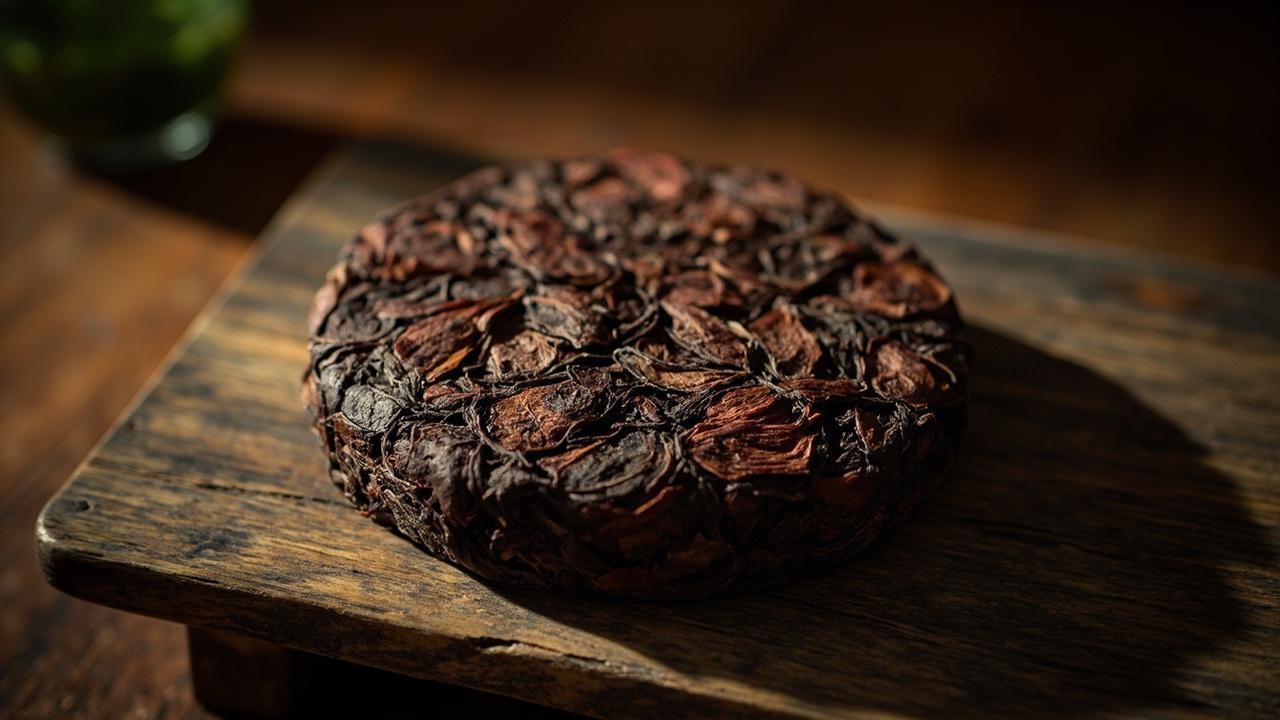
Shou puerh (熟普, “ripe pu-erh”) is Yunnan’s accelerated-fermentation dark tea — invented in the 1970s at the Menghai Tea Factory, it uses the wo-dui (wet-piling) process to mimic decades of natural aging in a matter of months [1]. The result is a thick, dark-red liquor with rich earthy, woody, and sometimes sweet date or chocolate notes. This guide covers the wodui process, shou grade classification, flavor evolution across storage years, gongfu brewing tailored to ripe pu-erh, and how to choose your first shou cake.
What Is Shou Puerh?
Shou puerh is one of two paths for Yunnan’s post-fermented dark tea. Both start from the same Dayeh broad-leaf varietal (Camellia sinensis var. assamica), harvested in Yunnan’s Xishuangbanna, Pu’er, and Lincang regions [1]. The difference is what happens after sun-drying.
Sheng (生, “raw”) pu-erh is compressed directly after sun-drying and left to age naturally — a process that takes decades to fully mature. Shou (熟, “ripe”) pu-erh skips the waiting. Instead of slow oxidation, the leaves undergo a controlled microbial fermentation called wo-dui that compresses thirty years of aging into 45–60 days [1].
The result is dark, earthy tea that’s drinkable the year it’s made, starting from a later point on the maturity curve than sheng.
If you’re new to pu-erh, our guide to Sheng Puerh covers the raw path in detail.
The Wodui Process — Beyond the 1970s Invention
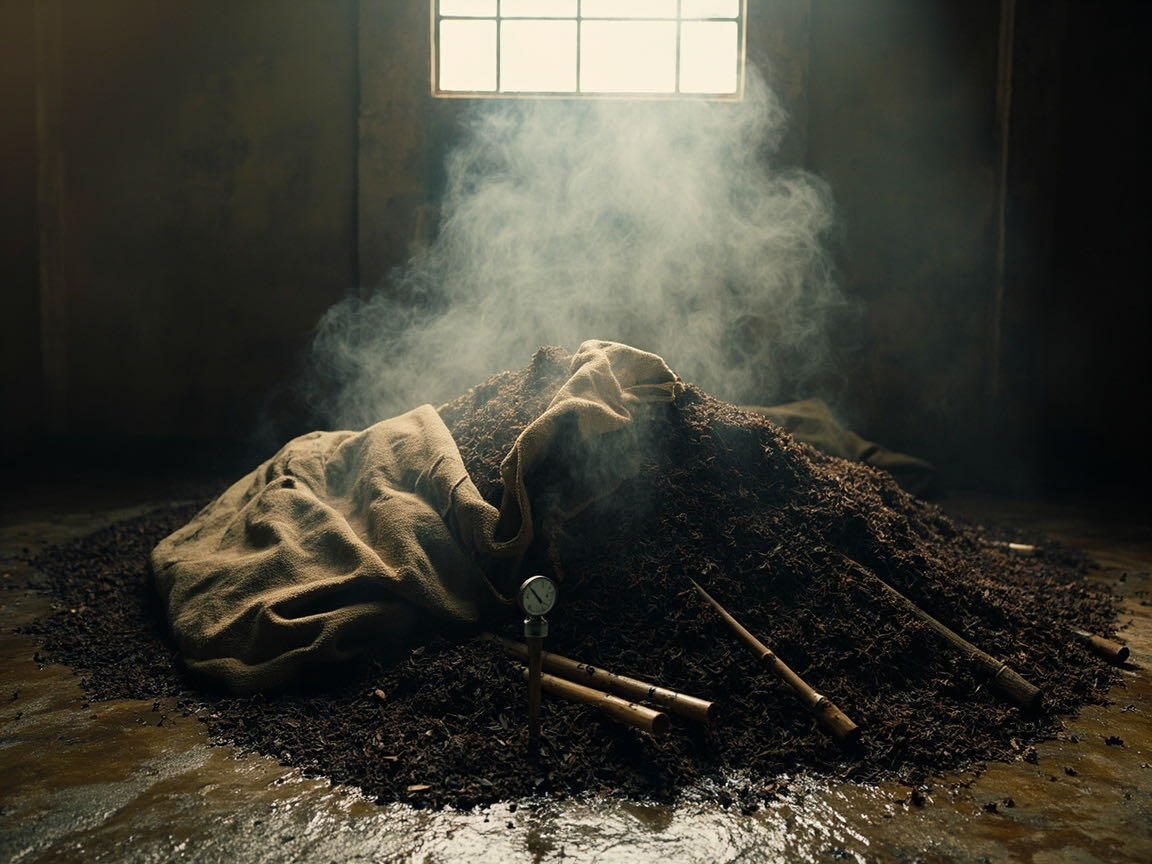
Wo-dui (渥堆, “wet piling”) isn’t just a single step — it’s a controlled fermentation environment that transforms raw leaf into ripe tea through heat, moisture, and microbial activity [1].
Here’s how it actually works. Freshly sun-dried maocha (rough tea) is piled 1–1.5 meters high on a concrete floor and covered with canvas. Water is sprayed onto the pile to raise moisture content to 30–40% — compared to roughly 10% for dry-stored sheng. The pile generates its own heat: internal temperature stays between 50–65°C (122–150°F), monitored and adjusted by regular turning with pitchforks [1].
Workers turn the pile every 2–3 days in the first week, then every 5–7 days as fermentation stabilizes [1].
Microbial activity drives the transformation. The dominant species is Aspergillus niger, a fungus that breaks down leaf cell walls, converts catechins (bitter compounds) into theaflavins and thearubigins (the compounds behind shou’s dark liquor and smooth body), and produces the characteristic earthy aroma [1]. Bacillus, Streptomyces, and other bacteria contribute secondary notes.
After 45–60 days, the pile is spread thin to dry and stop fermentation. The leaves are then graded by size and compressed into cakes, bricks, or bamboo tubes.
Understanding this process explains why shou quality varies so much. Pile temperature, turning frequency, moisture level, and even the age of the factory floor all affect the final flavor [1]. A well-managed pile produces clean, sweet shou — a rushed pile gives muddy, flat tea.
A good example of standard-grade wodui shou is the Jinglong Tea Factory bamboo tube cake ($18.99).
Shou Puerh Grade Classification
After wodui fermentation, the tea is graded by leaf size and fragment ratio. These grades determine both price and flavor profile.
Gongting (Imperial) grade (宫廷). The finest material from the innermost part of the pile — mostly buds and smallest leaf fragments. Gongting shou is smooth, thick, and sweet with minimal earthiness. It’s the most expensive grade and often reserved for higher-end cakes and gift boxes [1].
Premium grade. A mix of buds and larger leaf pieces. This is the most common grade in mid-range products — balanced between body and sweetness. Most loose-leaf shou on the market falls here.
Standard grade. Coarser leaves with some stems and larger fragments. Standard grade has a cleaner but less nuanced flavor. It’s often used for tea bags, restaurant pu-erh, and bulk blends.
Blended grade. Multiple grades or vintages combined for a consistent house profile. Blending is common for large producers who need the same taste year after year.
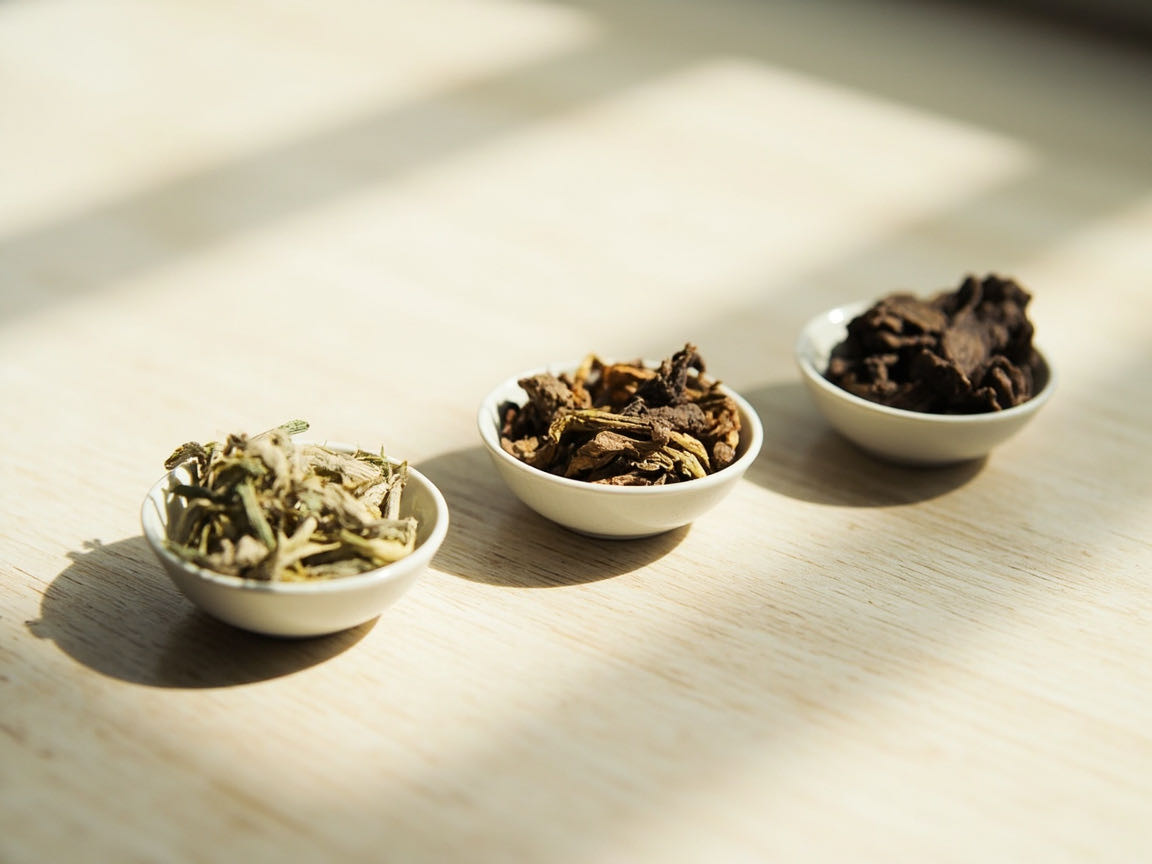
Visually: gongting grade shows fine golden hairs (hao) on tiny leaf buds. Premium grade mixes golden and dark fragments. Standard grade is darker with larger pieces and stems [1].
The TIAN HU SHAN ripe loose leaf (8 oz) ($13.49) is an easy daily shou without cake tools. The Soilmount tea bags ($9.99) are a standard-grade entry point.
Flavor Profile — Young vs Aged Shou
Shou’s flavor changes dramatically over time, just like sheng’s — but the trajectory is different because it starts from a later point.
Young shou (0–3 years). The dominant notes are mushroom, damp earth, and compost — what Chinese drinkers call dui wei (堆味, “pile flavor”). This is the residual taste of the wodui process, and it’s normal. Young shou also has a thicker body and darker liquor than aged shou. The dui wei fades noticeably within the first year [1].
Mid shou (4–8 years). As the pile flavor recedes, secondary notes emerge: woody, dark chocolate, dried dates, and a gentle sweetness. The body remains full but becomes smoother. Most drinkers consider this the sweet spot for daily shou drinking.
Aged shou (10+ years). At this stage, the pile flavor is completely gone. The profile shifts to medicinal herbs, camphor, dried longan, and a clean sweetness that lingers. Earthiness is reduced to a background note. The liquor lightens from ink-black to deep ruby [1].
Compare this to sheng’s flavor trajectory: sheng goes bright → fruity → woody → camphor over decades. Shou starts at approximately the midpoint of that curve, then continues toward camphor and medicinal notes.
Storage environment matters too. Dry-stored shou ages cleaner and sweeter. Humid-stored shou develops deeper earth and more body but can taste flat if over-humidified.
As an aged example, the SANRAN 2015 shou cake ($28.99) is an 8-year-old 357g bing with resolved pile flavor — ready to drink now or cellar further. For younger shou that shows the dui wei stage, the MOORCHOCO mini cakes ($20.99) give you 60 small portions to track flavor change over time.
How to Brew Shou Puerh
Shou puerh needs a brewing approach that’s different from both sheng and other dark teas. The leaf is more fragile from the wodui process, and fine particles are common.
Rinse is mandatory. Shou always needs 1–2 quick rinses (10 seconds each) before the first drinkable steep. The first rinse wakes the compressed leaf. The second rinse helps wash away fine dust from the pile process. After each rinse, smell the wet leaf — that aroma tells you whether the shou is clean or has residual pile flavor [1].
Temperature: full boiling 212°F (100°C). Shou needs more heat than sheng because the wodui process has already broken down most of the volatile aromatics. Boiling water extracts the deeper, mature flavors. Don’t be afraid of scorching the leaf — shou can handle it.
Gongfu method (recommended). Use 5–8g leaf per 100ml vessel in a gaiwan. First steep: 10–15 seconds. Add 3–5 seconds per subsequent steep. Shou yields 8–12 infusions [1].
Western method. Use 3g leaf per 200ml water. Steep 3–5 minutes for the first infusion, then 5–7 minutes for a second. Two infusions maximum before the leaf is spent.
The key difference from sheng: shorter initial steeps (sheng starts at 15–20s, shou at 10–15s) and more rinses. Shou leaf opens faster because the pile process has already softened the cell structure. After 6–8 steeps, extend to 20–30 seconds to keep extraction consistent.

The XIXICHA premium ancient tree cake ($29.65) is a good high-grade shou to practice gongfu on — its clean fermentation produces clearly distinguishable steep-to-steep transitions.
Shou Forms and Variants
Shou puerh comes in several compression forms, each suited to different drinking habits.
Cake (bing, 饼). The round disc is the standard format — traditionally 357g, now also available in 200g or 100g sizes. A bing needs a pu-erh pick to break off portions. This is the form for aging: the dense compression protects the leaf from over-oxidation. Most aged shou you’ll find is in cake form [1].
Bamboo tube (zhu tong, 竹筒). Individual mini-cakes (mushroom-shaped or nugget-like) wrapped in bamboo leaves. No pick needed — just pull one out and brew. The bamboo adds a subtle woody note. Good for travel and gongfu sessions [1].
Brick (zhuan, 砖). Compressed rectangle or square. Bricks are transport-friendly and often used for bulk aging. Some bricks have breakaway score lines for easy portioning.
Loose leaf. No compression at all — processed directly from the pile into bags or tins. Convenient for daily gongfu without dealing with a cake pick. Loose leaf often uses premium-grade material.
Chenpi (tangerine peel, 小青柑 xiao qing gan). A popular modern variant: young green tangerines are hollowed out, stuffed with shou puerh, and dried together. The citrus peel cuts through shou’s earthiness with a bright, aromatic layer. Brew the whole tangerine or break it into pieces [1]. This is a flavored variant, not a traditional grade — but it’s one of the most popular shou products on Amazon.
For form variety, here are the picks:
- Bamboo tube (daily) — MOORCHOCO 60 mini cakes ($20.99), convenient individual portions
- Brick (travel) — NASLAPH mini brick 25-pack ($19.99), breakaway pieces
- Loose leaf (daily drinker) — Organic Positively 16oz ($35.95), smooth clean profile
- Chenpi (flavored gateway) — NASLAPH tangerine peel shou ($24.99), citrus + earthy
Choosing Your First Shou
Four decision paths, depending on what you want from shou:
First-timer ($10–15). Start with low commitment. The Soilmount tea bags ($9.99) let you taste shou with zero gear. Or try the TIAN HU SHAN ripe loose leaf (8 oz) ($13.49) with just a mug and hot water.
Daily gongfu drinker ($18–25). Best value per cup comes from full-sized formats. The GLDNT organic loose-leaf 16oz ($19.99) gives you bulk organic shou for everyday sessions. The Jinglong bamboo tube cake ($18.99) is a classic entry-level cake.
Flavor explorer ($28–35). Aged shou shows you how ripe pu-erh develops over time. The SANRAN 2015 cake ($28.99) has 8+ years of clean storage. The XIXICHA ancient tree premium ($29.65) offers higher leaf grade and returning sweetness (huigan).
Convenience seeker ($10–25). Skip the cake pick entirely. NASLAPH mini bricks ($19.99) and MOORCHOCO mini tube cakes ($20.99) are pre-portioned. The NASLAPH chenpi shou ($24.99) adds citrus flavor with zero extra effort.
Related Varieties
These sister articles explore related teas:
- Sheng Puerh — raw pu-erh, the natural aging path
- Tieguanyin — Anxi rolled oolong with orchid aroma
- Keemun — Qimen black tea with cocoa notes, a good dark-tea comparator
- Da Hong Pao — Wuyi rock oolong, roasted mineral depth
- Matcha — Japan’s stone-ground green tea, a completely different processing path
- Longjing — China’s pan-fired Dragon Well green tea
- Silver Needle — Fujian bud-only white tea, gentle and sweet
For a caffeine comparison across tea types, see our wellness guide on caffeine by tea type.
Sheng Puerh covers compression forms, aging milestones, and mountain terroir.
The Mind of Shou Puerh
The Mind of Shou Puerh is about patience made accessible. Where sheng asks you to wait decades for transformation, shou compresses a lifetime of change into a single session — mushroom turning to chocolate turning to camphor across twelve steeps. Each infusion is a small lesson in impermanence: nothing stays the same, not even earthiness. Sit with the shift. Let the cup show you how time works, even when it’s sped up.
References
[1] Wikipedia contributors. Pu-erh tea. https://en.wikipedia.org/wiki/Pu-erh_tea — Yunnan origin, Dayeh broad-leaf varietal, wo-dui (wet-piling) process invented at Menghai Tea Factory in the 1970s, microbial activity (Aspergillus niger), pile turning temperature (50–65°C internal), moisture content (30–40%), 45–60 day duration, grade classification (gongting/premium/standard/blended), shou vs sheng distinction, gongfu and Western brewing parameters, compression forms (bing/tuo/zhuan), flavor evolution across storage years, chenpi variant, and storage effects.